This section documents the development of my project in MA Applied Imagination at Central Saint Martins, focusing on the practical interventions and iterations of my research on Neurodiversity and Posthumanism.
‼️Since the journals are arranged in reverse order, I suggest starting from the first journal at the bottom.
🧠for journals more emotional and reflective; ✒️for journals more rational and analytical
This is Unit 4’s Blog. Click here to read UNIT 1-3
✒️Analysis for Iterated Workshop 2.0
📆5/11/2025
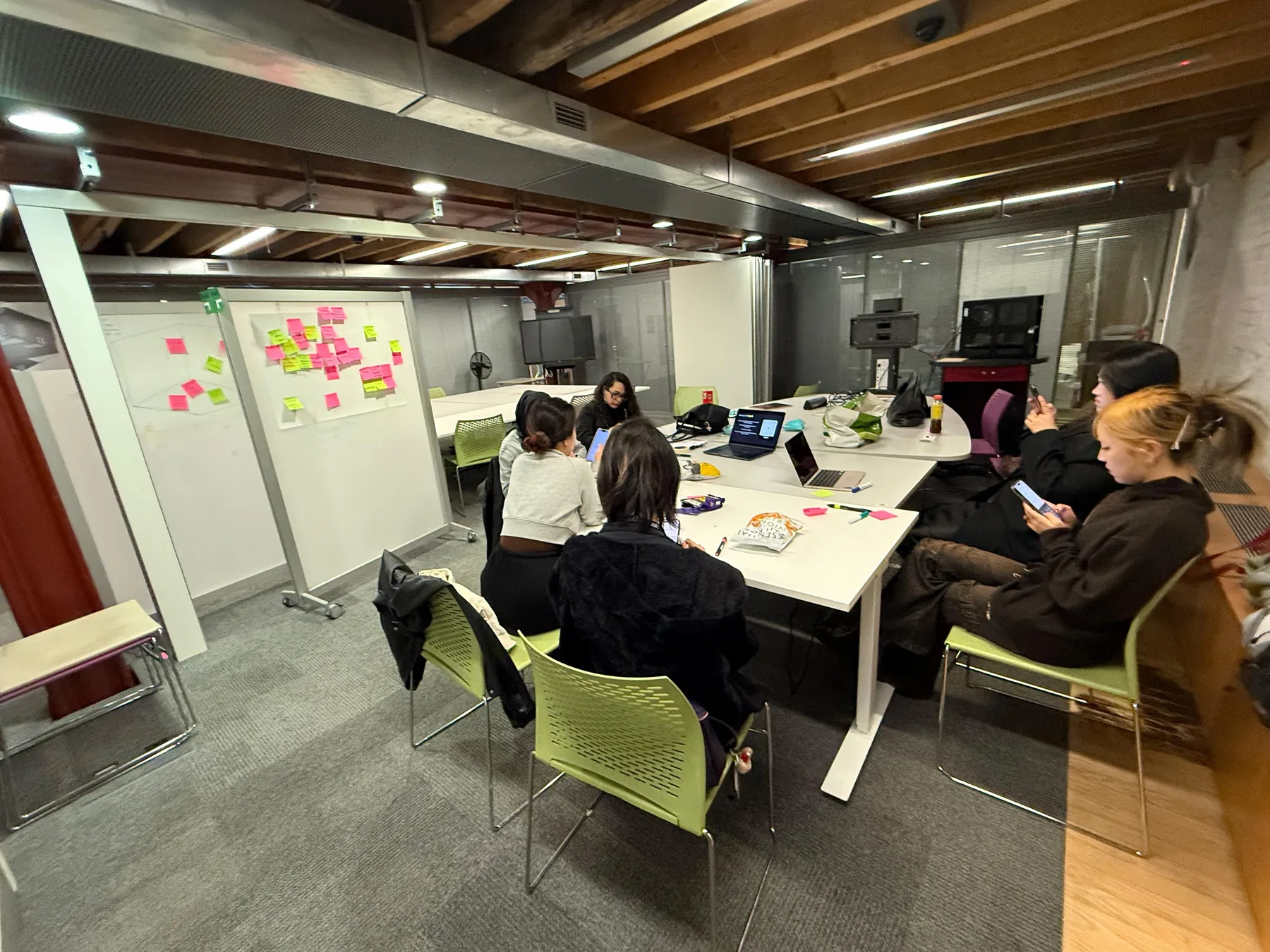
Today I finished the The second round of the workshop at CSM. It progressed more closely in line with the research objectives. Through structural and procedural iteration, the process became more controlled and realistic, allowing participants’ actions and responses to more concretely expose the tensions between the paradigms of inclusion and symbiosis framework that I want to test or practise from the paper.
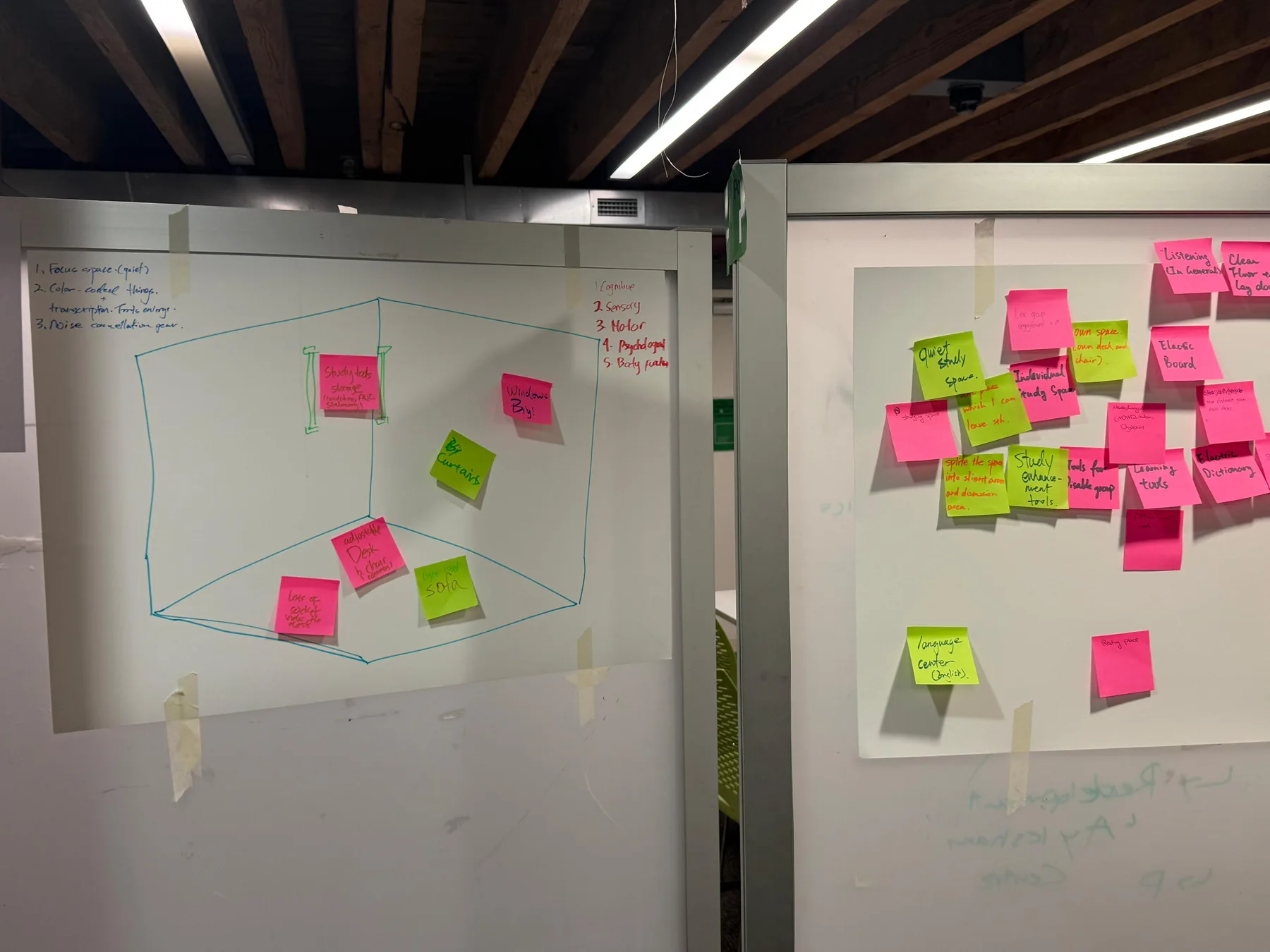
This round consisted of two sessions, with six participants, roughly mirroring the composition of the first iteration. The workshops took place in the group study rooms of library, quiet and enclosed environments that enabled close observation of interactional dynamics. The overall theme remained the same: designing a shared learning space for MA Applied Imagination students. The difference from the one on Monday’s workshop, lay in framing: Task A was redefined as an “inclusive retrofit under constraints,” while Task B focused on “co-designing from embodied needs.”
In Task A, the voting for a leader was removed, and several practical constraints were introduced: the space’s main function (quiet study) had to be preserved; walls and lighting could not be altered; new facilities could only be added to improve inclusivity. These conditions forced participants to work within an inflexible framework, discouraging imaginative overreach and prompting negotiation over trade-offs. The discussion became more grounded but also more conflicted. Some members hesitated to speak, and much of the time was spent debating what “inclusive” even meant, rather than developing concrete designs. Although there was no formal leader, those who spoke more quickly or confidently naturally assumed dominant roles. One participant noted feeling disrespected because her ideas were repeatedly ignored or rephrased by others. Language asymmetry also surfaced as a structural factor: a non-native English speaker reflected that she often responded more slowly in English and therefore missed opportunities to contribute. The atmosphere was not hostile, but notably tense, and authority was unevenly distributed.
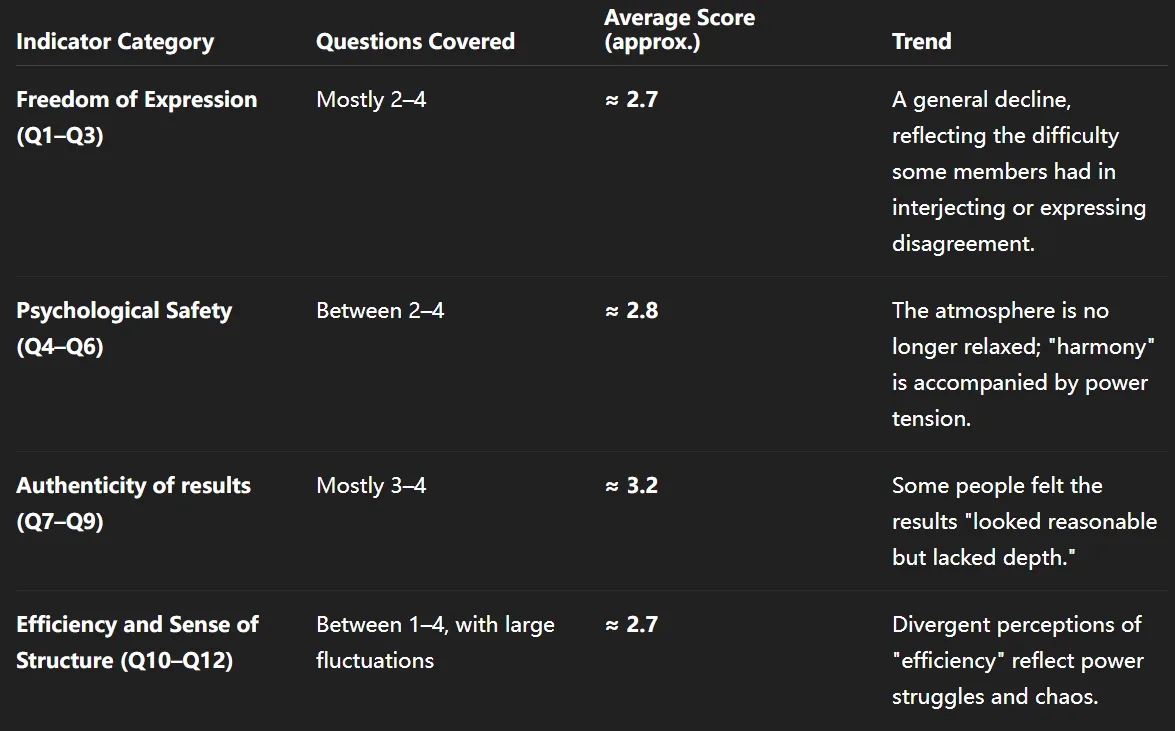
Quantitatively, Task A scored lower overall than in the first round, with means clustering between 2.5 and 3 on a 5-point scale. Participants rated freedom of expression and psychological safety lower, while outcome coherence remained moderate, suggesting that although the final product seemed reasonable, participation was uneven. Some described the process as “interesting” or “harmonious,” while others used words like “dictating” or “overthinking,” revealing divided experiences between those who led and those who followed. Compared with the previous session’s more imaginative atmosphere, this iteration of Task A more accurately resembled institutional reality: participants were compelled to fit difference into an existing frame rather than reinvent the frame itself. The frustration that emerged became the most valuable outcome: it made visible the paradox of inclusion as a bounded and managerial practice rather than an open one.
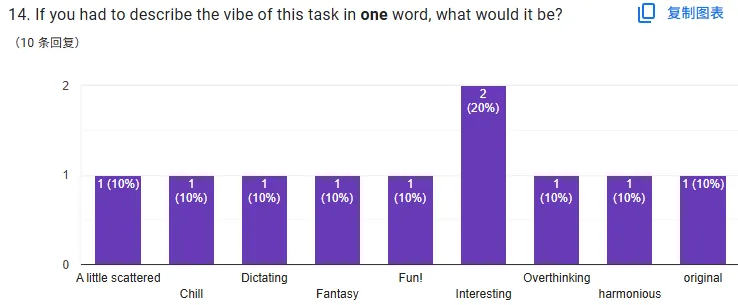
one word description for Task A
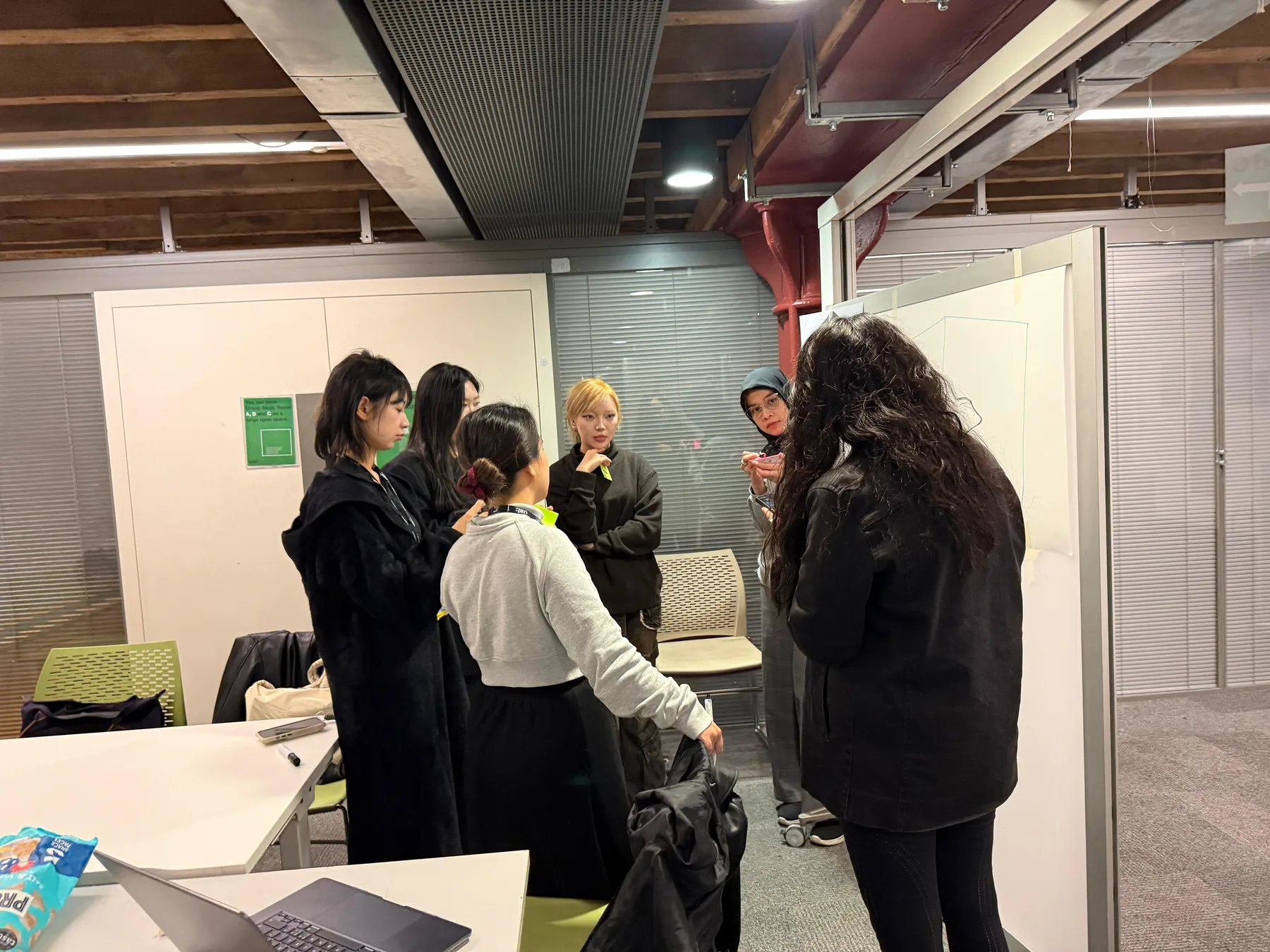
Task B, in contrast, benefitted from significant design refinements. I provided clear, phased instructions than last time: first, participants individually wrote down their needs and the needs others (neurodivergents, disabled, international students, etc.) might have on sticky notes; then, they clustered and negotiated their relations. Most participants understood the process well and stayed focused on balancing competing needs. The data show higher average scores than Task A (roughly 3.2–3.5), especially in psychological safety and process clarity. Many participants felt their voices were heard, and some commented that the discussion was more directed. Still, authority did not vanish. In the absence of a formal leader, several proactive members again became the actual coordinators. One participant remarked that without someone who understood the procedure, the group risked “chaos.” This suggests that participants continue to reconstruct hierarchy as a source of security even within “leaderless” settings.
This pattern reveals an important point I found it probably the most thought-provoking: symbiosis does not eliminate power; it redistributes and transforms it. In Task B, authority operated less through dominance than through initiative and responsibility. Leadership shifted moment by moment, embedded in gestures, turns, and small acts of coordination. The power dynamic was less coercive but more diffuse, continuously negotiated through the rhythms of interaction.
The qualitative feedback also pointed to cognitive and sensory dimensions of collaboration. Several participants observed that greater diversity in ideas produced a heavier informational load, making the process “more complex” or “harder to digest.” One asked, “Does more inclusive mean more stimulation?” Such remarks highlight that inclusion and diversity are not purely ethical concerns but perceptual and neurological ones. The experience of cognitive saturation, the need to process multiple, sometimes conflicting inputs, reflects the neuro-political conditions of contemporary learning spaces and ties directly to the project’s central argument: neurodiversity as a posthuman condition.
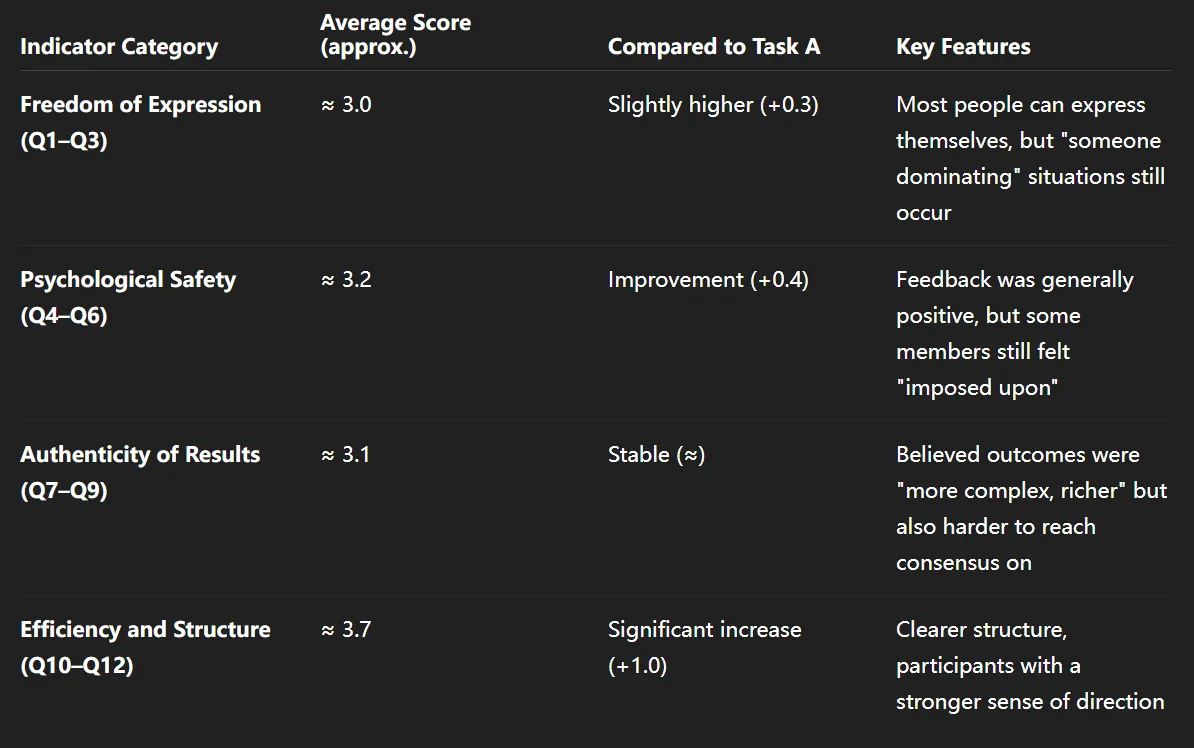
And, in general, across both workshop rounds, the contrast between Task A and Task B has become increasingly distinct and consistent. Although the two experiments differed slightly in setting, group composition, and the level of instruction, the overall pattern remained the same: Task A repeatedly manifested a kind of formal order sustained by internal inequality, whereas Task B revealed a generative disorder sustained by relational authenticity. The first was more efficient and easier to complete, yet it consistently suppressed individual difference and non-normative expression. The second was more open and affectively engaging, but also exposed difficulties of coordination, moments of overload, and the tendency for structure to re-emerge.
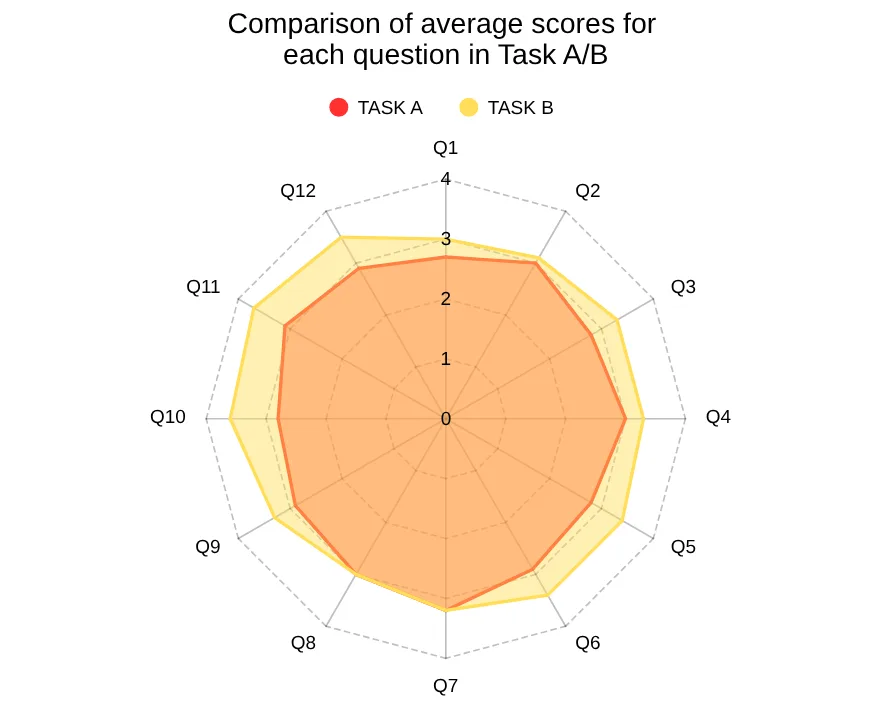
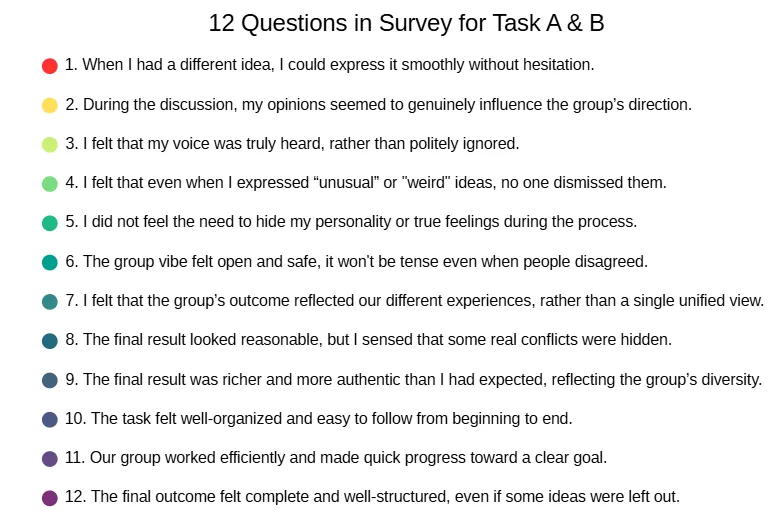
Quantitatively, Task A scored lower than Task B in both rounds. In the first iteration, the mean scores were approximately 3.4 for Task A and 3.7 for Task B. In the second, Task A dropped to around 2.8 while Task B remained stable between 3.2 and 3.4. This pattern suggests that participants consistently experienced the “inclusive” scenario as more constrained and passive, whereas the “symbiotic” scenario, although less predictable, gave them a stronger sense of presence and agency. In specific dimensions, Task A scored higher on “efficiency and structure” but lower on “freedom of expression” and “psychological safety.” In other words, the inclusion paradigm functioned as a bureaucratic logic of organisation: it guaranteed order by reducing variance. The symbiotic paradigm, in contrast, traded clarity for openness, and allowed difference to become visible and felt.
The qualitative materials make this difference more tangible. Task A discussions were often described as calm or efficient, yet accompanied by words such as ignored, dictating, or unbalanced. Task B elicited more ambivalent responses: inclusive, rich, and easy appeared alongside complex, chaotic, and too fast. Such duality indicates that the symbiotic situation did not simply make participants “happier.” Rather, it forced them to confront the difficulty of coexistence without fixed rules. Task A tended to conclude with a single, tidy diagram or sentence of consensus; Task B produced a multilayered of meanings, where the distance and relation between notes carried more information than any unified statement.
This divergence in form mirrors the conceptual distinction between the two paradigms. The outcome of Task A (a coherent definition or standardised layout) embodies the logic of inclusion: the pursuit of clarity and boundary through the containment of conflict. Task B, instead, generates its own relational order from below. Its outcome is not an end point but an ongoing topology of negotiations. Participants did not simply collaborate; they learned to perceive the other through misunderstanding, partial comprehension, and hesitation. In this sense, misunderstanding became not a failure but a productive state of relation.
The comparison between the two workshop rounds also reveals an evolution. In the first iteration, Task A tended toward abstraction and fantasy, while Task B risked dissolution through lack of structure. In the second iteration, by introducing material constraints and phased guidance, the contrast became analytically stable. Once inclusion was grounded in real institutional conditions, its exclusionary mechanisms surfaced immediately; once symbiosis was given minimal scaffolding, it became observable as a practical and cognitive process rather than an ideal. This shift provided an empirical grounding for the theoretical argument and opened a further question: can there be a structured symbiosis: a mode of collective organisation that keeps difference visible without reproducing hierarchy?
In the end, I think the significance of these two experiments lies not in determining which paradigm “works better,” but in exposing the limits of each. Task A represents the inclusion strategies typical of modern institutions: polite, procedural, and replicable, yet sustained by the erasure of difference. Task B represents a still-fragile practice of symbiosis: unstable, sometimes incoherent, yet capable of revealing genuine moments of equality and connection. Through these contrasting failures and partial successes, the research shifts its central question from how to include difference to how to coexist with what cannot be fully understood.
Appendix
Survey Respond Form of Task A https://docs.google.com/spreadsheets/d/1UnOwyl8b78oetyaOeBmRE2X_IGBkrBozKifbWLFVFLU/edit?usp=sharing
Survey Respond Form of Task B https://docs.google.com/spreadsheets/d/1Fdlcwo1noa_9GSW8vDJuntHslqXxoLVUIKM_CE90tio/edit?resourcekey=&gid=1184682712#gid=1184682712
Workshop Slides https://docs.google.com/presentation/d/1gERIL0TwlvTjFZZsCliZjybNAKd0ksuaCQXyqvkMjVg/edit?usp=sharing
✒️Analysis for Workshop 1.0
📆4/11/2025
Today I did serious analysis about the workshop and data collected yesterday. There are two tasks in this workshop, Task A (Inclusion Paradigm) and Task B (Symbiosis Paradigm), each task represented a distinct mode of meaning-making: one rooted in institutional “inclusion,” and the other attempting to generate “symbiosis” through relational difference. Yet, the outcomes were far less binary than I had anticipated.
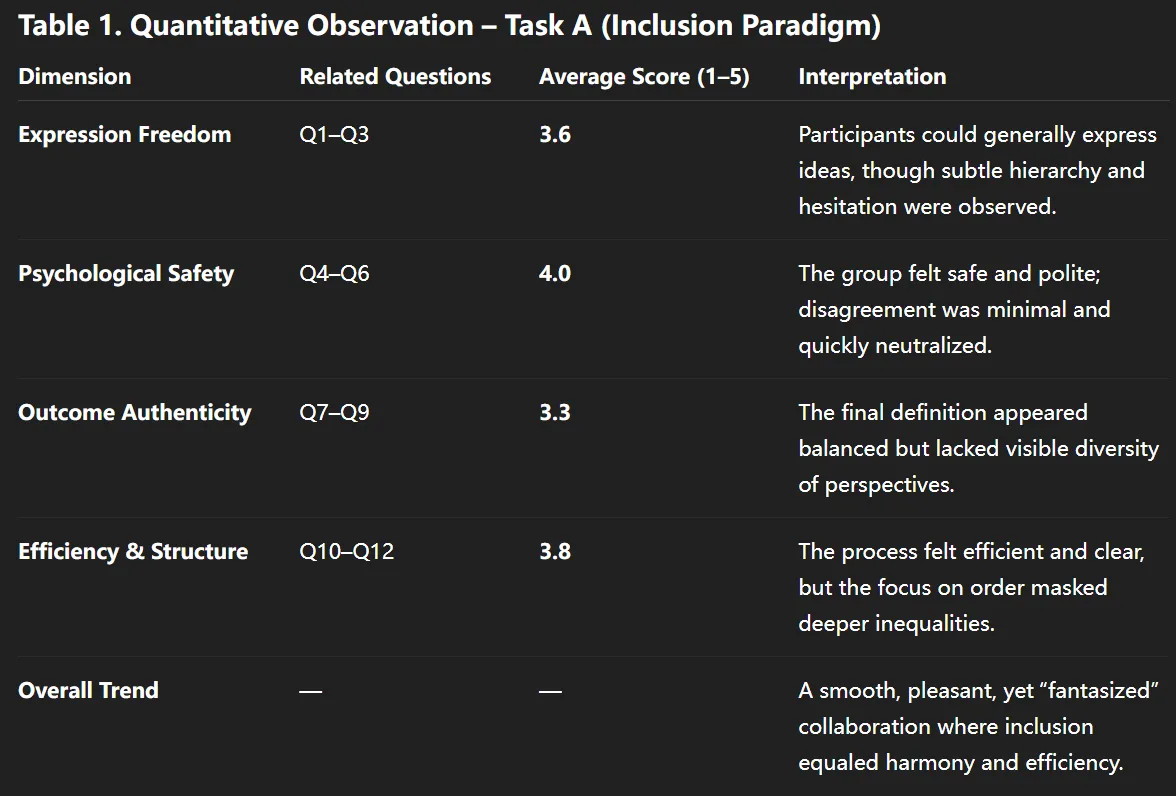
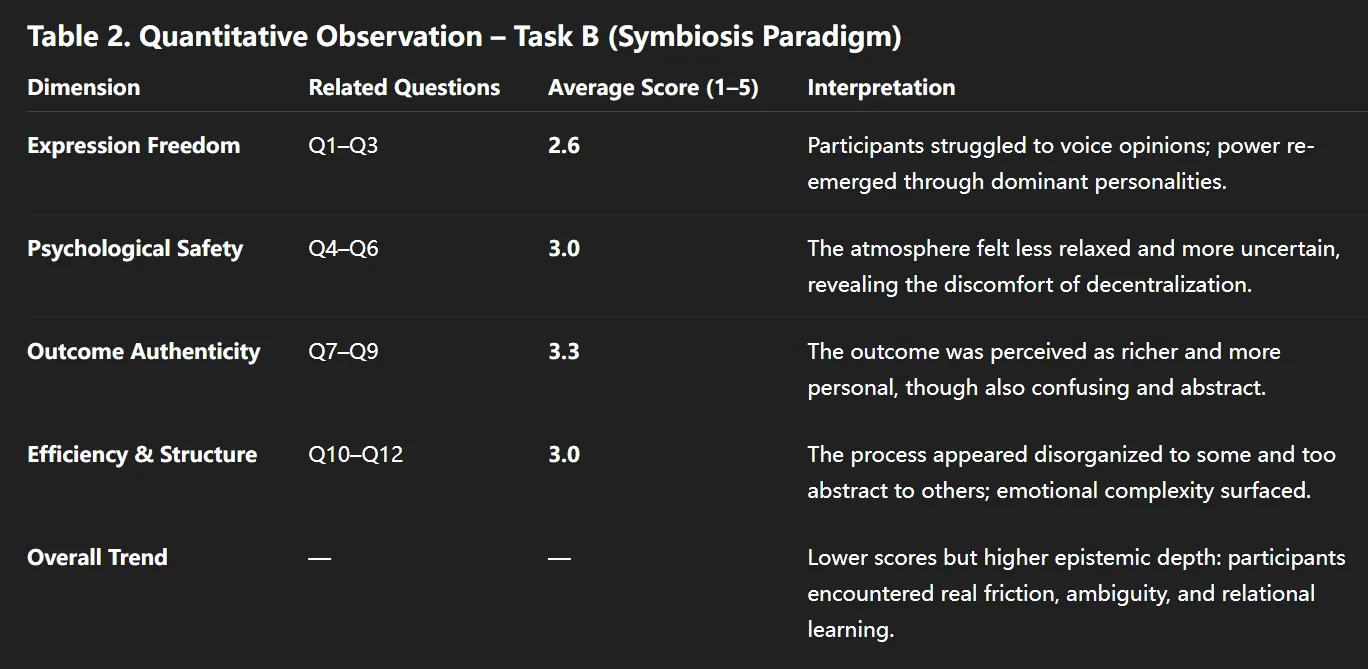
From the survey data, Task A showed consistently higher average scores than Task B. Task A scored particularly high on psychological safety (≈4.0) and efficiency and structure (≈3.8), while Task B fluctuated between 2.6 and 3.3 across indicators. This numerical contrast, however, does not mean that Task A was “better.” On the contrary, it reveals the central paradox of the inclusion paradigm: its sense of comfort is often sustained by the suppression of real difference and the masking of conflict.
Participants in Task A generally described the process as smooth, organized, and pleasant. Their keywords, “chill,” “fun,” “fantasy”, perfectly capture this affective tone. The group indeed showed creativity, but the creativity was “fantastical.” In the absence of real institutional constraints, participants did not reproduce the kind of power suppression I had expected; instead, they transformed the exercise into a game of imaginative redesign. Fantasy became a substitute for politics, a way to escape tension. While no one was explicitly excluded, several participants noted that “stronger voices could overpower the quiet ones.” What emerged was a form ofpolite inclusion, where hierarchy is disguised as harmony. The “pleasant” atmosphere itself functioned as a regulatory force.
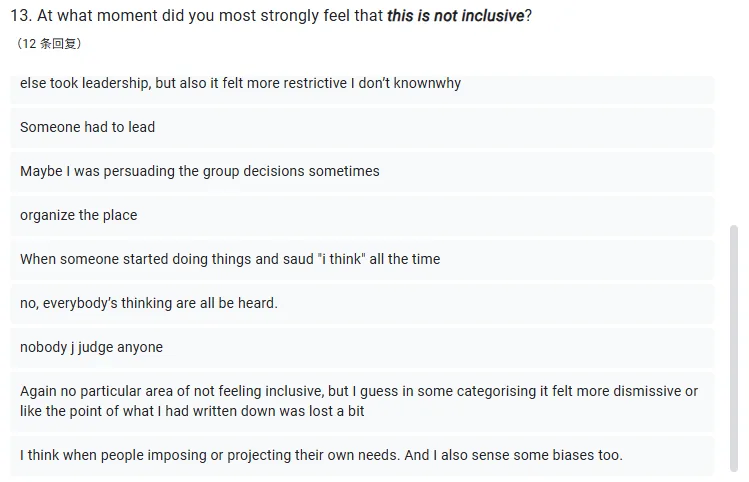
Task B, in contrast, was far more complex, and far more real. Average scores dropped, and responses became polarized. Some described the process as open-minded and thoughtful, while others found it confusing, abstract, or disengaging. Several noted that although there was “no leader,” dominant personalities “naturally took invisible leadership.” Others even described the task as “bossy” or “restrictive.” This shows that when formal authority is removed, power does not disappear, it reappears in subtler, interpersonal forms, enacted through tone, charisma, and spatial positioning. This finding is critical: symbiosis is not a natural condition but a learned and negotiated practice.
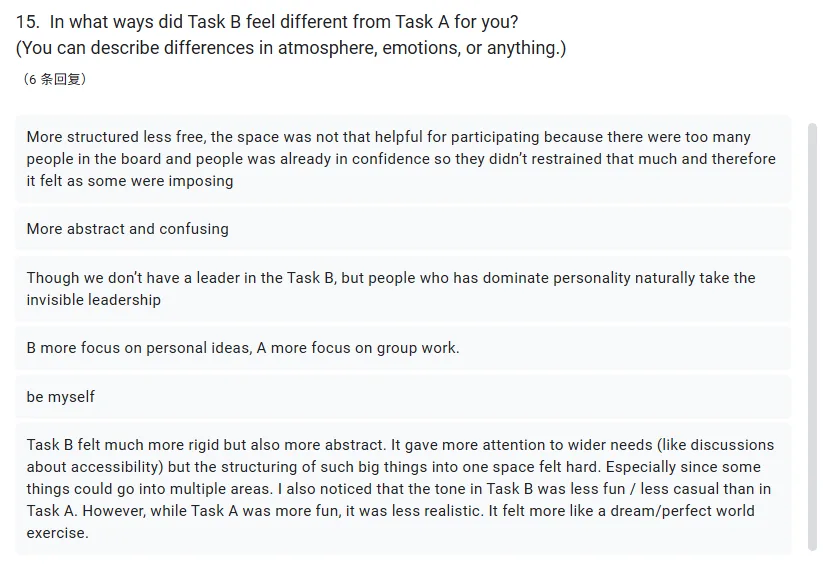
However, the lower scores in Task B do not indicate failure. Rather, they mark the emergence of cognitive friction, the difficulty of engaging with real difference. Many participants noted that Task B felt “more personal” and “more thoughtful” but also “more abstract and confusing.” In other words, when the group shifted from an institutional to a relational mode of thinking, they encountered disorientation. This discomfort is precisely the point of symbiosis: it forces participants to confront the limits of their own perception, to realize, experientially, that “I cannot perceive the needs I don’t have.”
Across both sessions, a clear trajectory emerged: Task A’s comfort derived from clarity and consensus; Task B’s discomfort arose from ambiguity and exposed difference. Theoretically, these correspond to the stability of inclusion versus the generativity of symbiosis. The former sustains order through efficiency; the latter generates meaning through friction. Task A thus represents a kind of cheerful suppression**, while Task B embodies an awkward authenticity.
This awkwardness is not a flaw but a sort of condition within posthuman frameworks. Once power is no longer centralized in a single subject, social collaboration loses its stable center. Participants are forced to negotiate in uncertainty, relationally, emotionally, and ethically. Anyway, in Task A, I will add more realistic constraints (budget limits, immovable structures, institutional approval) to prevent participants from escaping into imaginative idealism. This will allow the restrictive nature of inclusion to surface more concretely.
🧠Workshop
📆3/11/2025
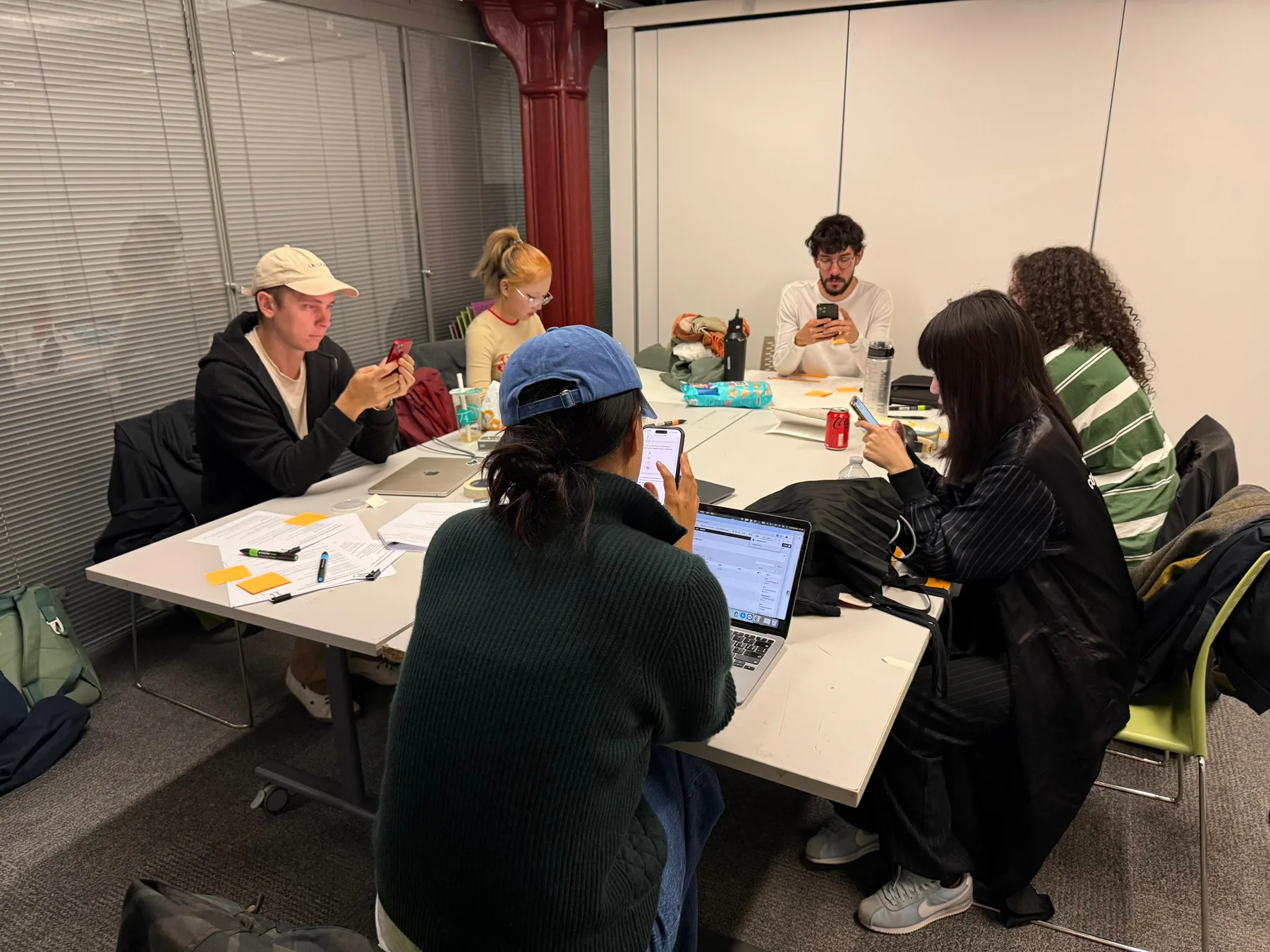
It’s Monday, and I finished both of my workshops today. This afternoon, I felt an incredible sense of decompression, I really, genuinely did not expect this. I actually managed to pull off this workshop, which was a huge psychological hurdle for me.
I have to say, the hardest part wasn’t when the workshop started or when I was $facilitating$ the flow, but the entire recruitment and logistics process beforehand. That was the real challenge, because it meant I had to talk to everyone, coordinate the plan, confirm times, manage $slots$, prepare materials, and coordinate groups. For someone like me, who is on the autism spectrum, this active, intense social communication and logistical organizing was the biggest mental obstacle. But I still finished it, and though it was tougher than I thought, the sense of accomplishment is also huge. Over ten people participated in total, and I completed two sessions in one day. I know that most of them were my friends, maybe coming just to support me, after all, my workshop didn’t pay money like some psychological or social experiments (my friend’s experiment paid $£10$ for an hour).
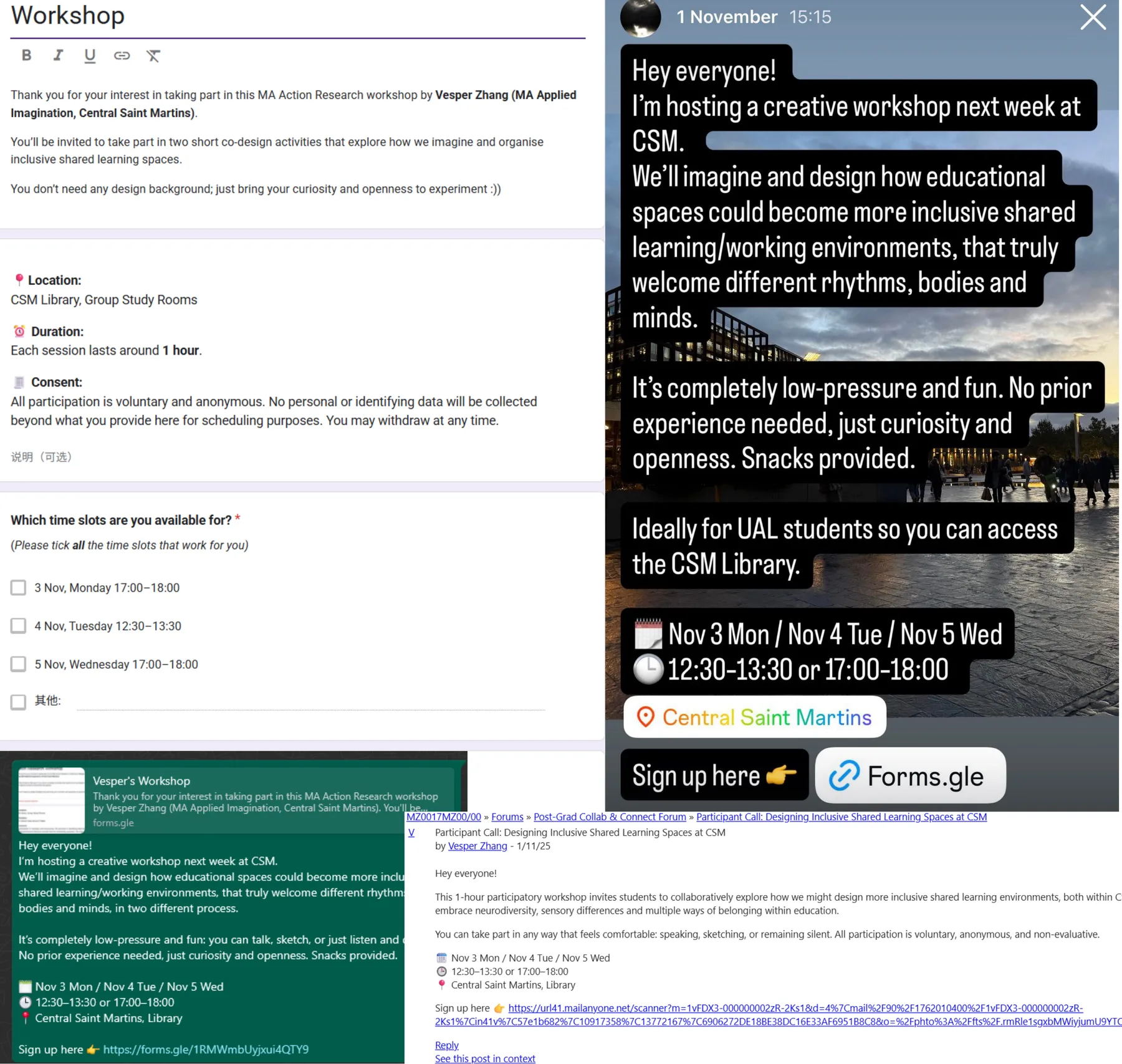
Anyway, I need to walk through the whole process and then reflect. I posted recruitment info separately in some $WhatsApp$ groups, on $Instagram$, and on the school forum. I created a questionnaire first, asking for names, emails, time $slots$, and a brief understanding of the workshop. Although not many people signed up in the first day or two, maybe a dozen, it was enough for me to conduct two action research sessions. So I scheduled them for Monday afternoon, $12:30\text{ to }1:30$ and $5:00\text{ to }6:00$, in the small group study room at the $CSM$ library.
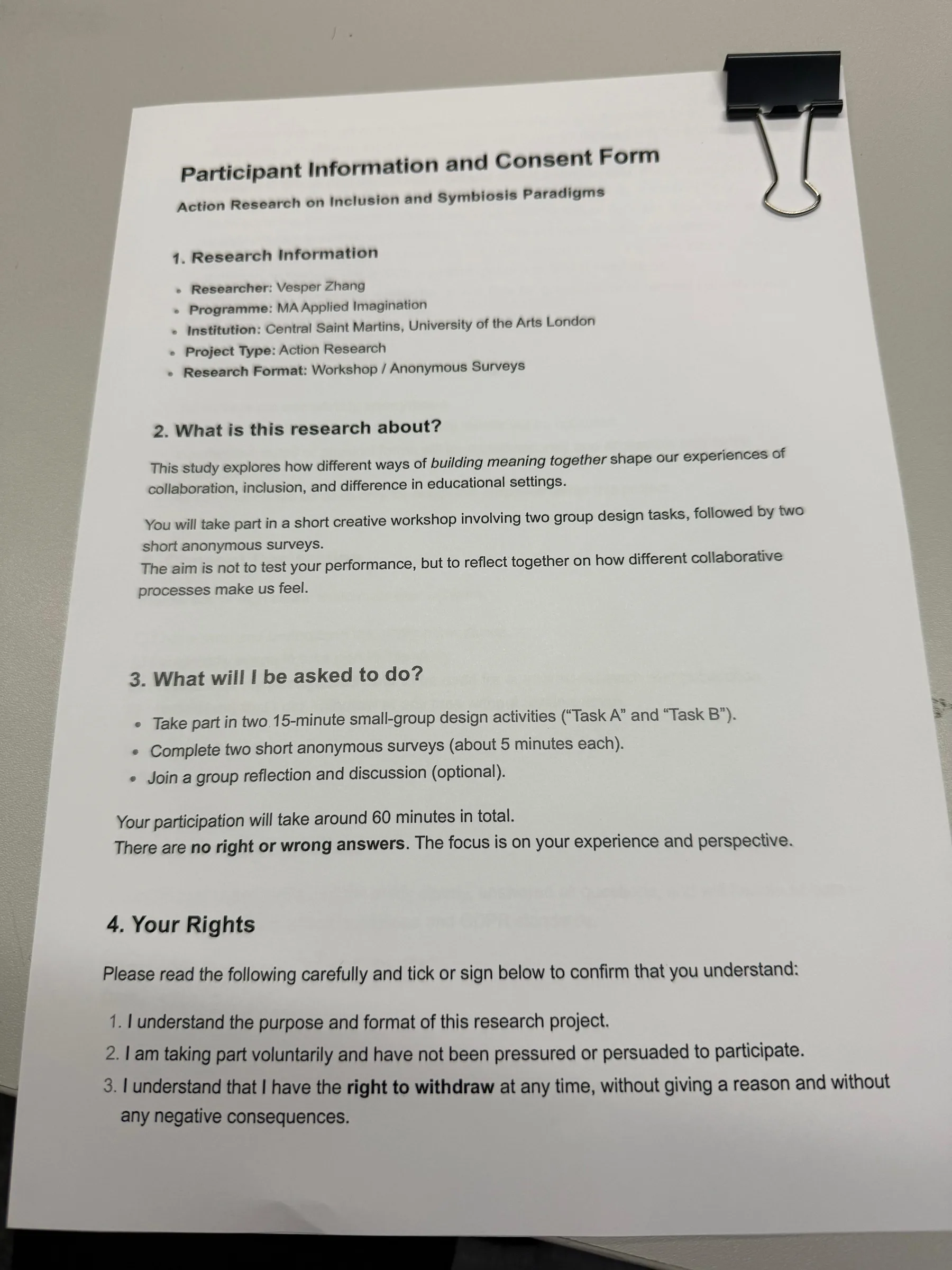
When the day arrived, I was pretty nervous at first. I prepared a $PPT$ and $Consent$ forms. The workshop was divided into two tasks with a shared goal: designing a collaborative study space for our $MA\ Applied\ Imagination$ program. We don’t have a dedicated studio, but $Fashion$ does, which I think is totally unfair considering the tuition we pay. I wanted to use this concrete design task to demonstrate my research, specifically, the difference between the Inclusion Paradigm and the Symbiosis Paradigm.
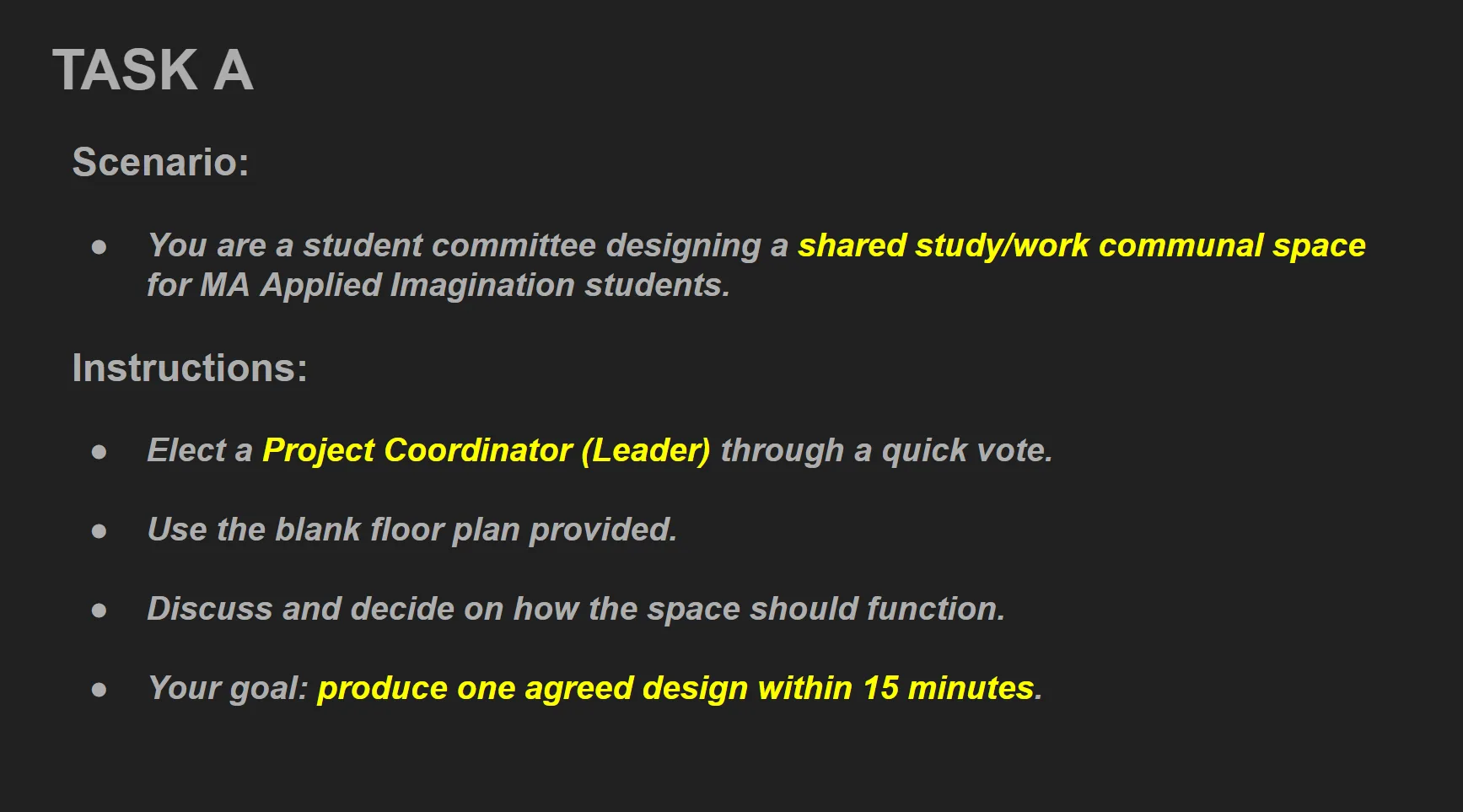
Task 1 represented the Inclusion Paradigm, which was $Top-down$. I asked participants to elect a $Leader$ who would then integrate and consolidate everyone’s ideas for the space. We used a large blueprint of a standard university classroom, and people used sticky notes for their ideas.
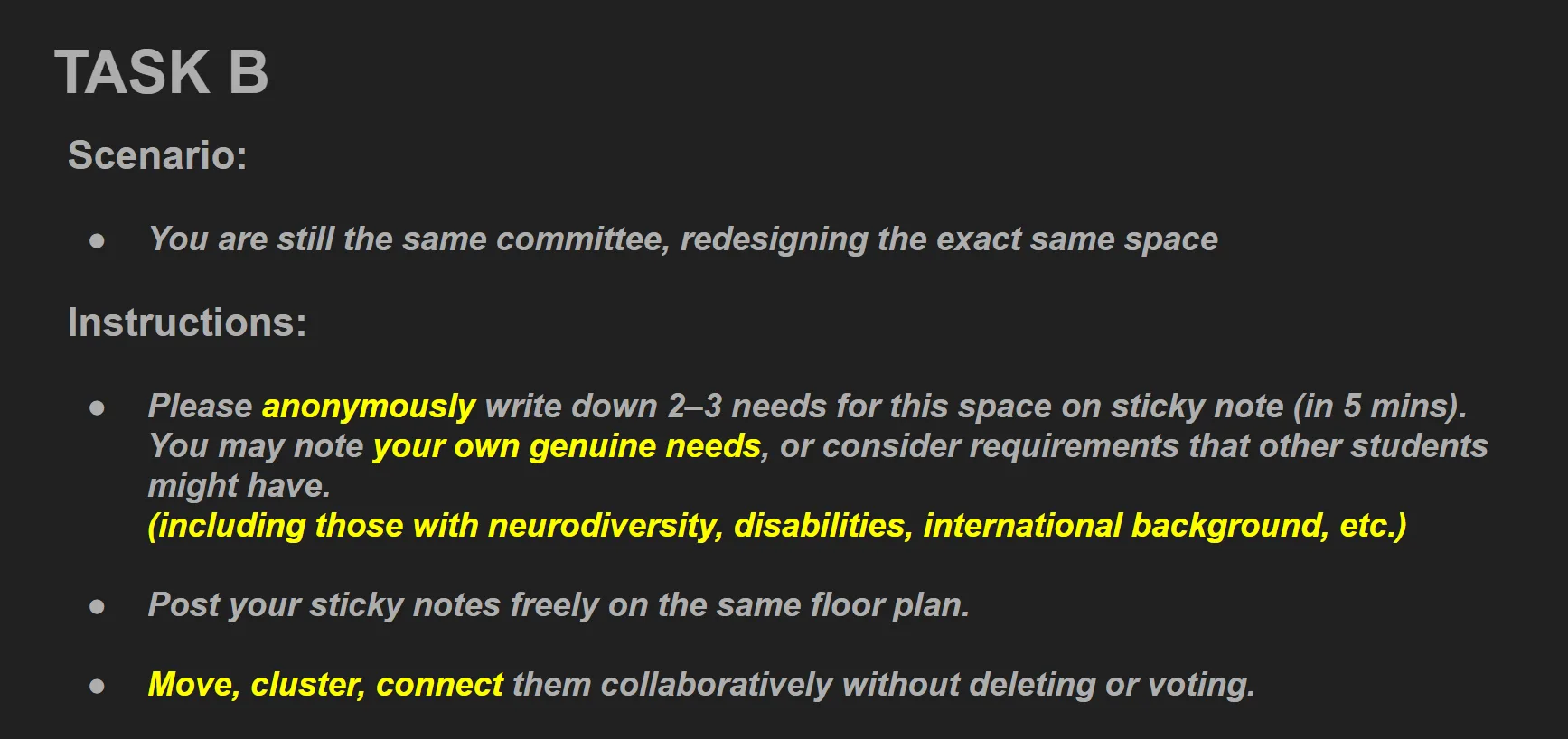
Task 2 represented the Symbiosis Paradigm, which was $Bottom-up$. There was no $Leader$. Everyone had to equally contribute two to three of their most genuine personal needs, plus any imagined needs of others (like neurodivergent, disabled, or international student needs). These were also posted on the blueprint, and the group discussed how they formed a relational map, spontaneously co-creating a space design.
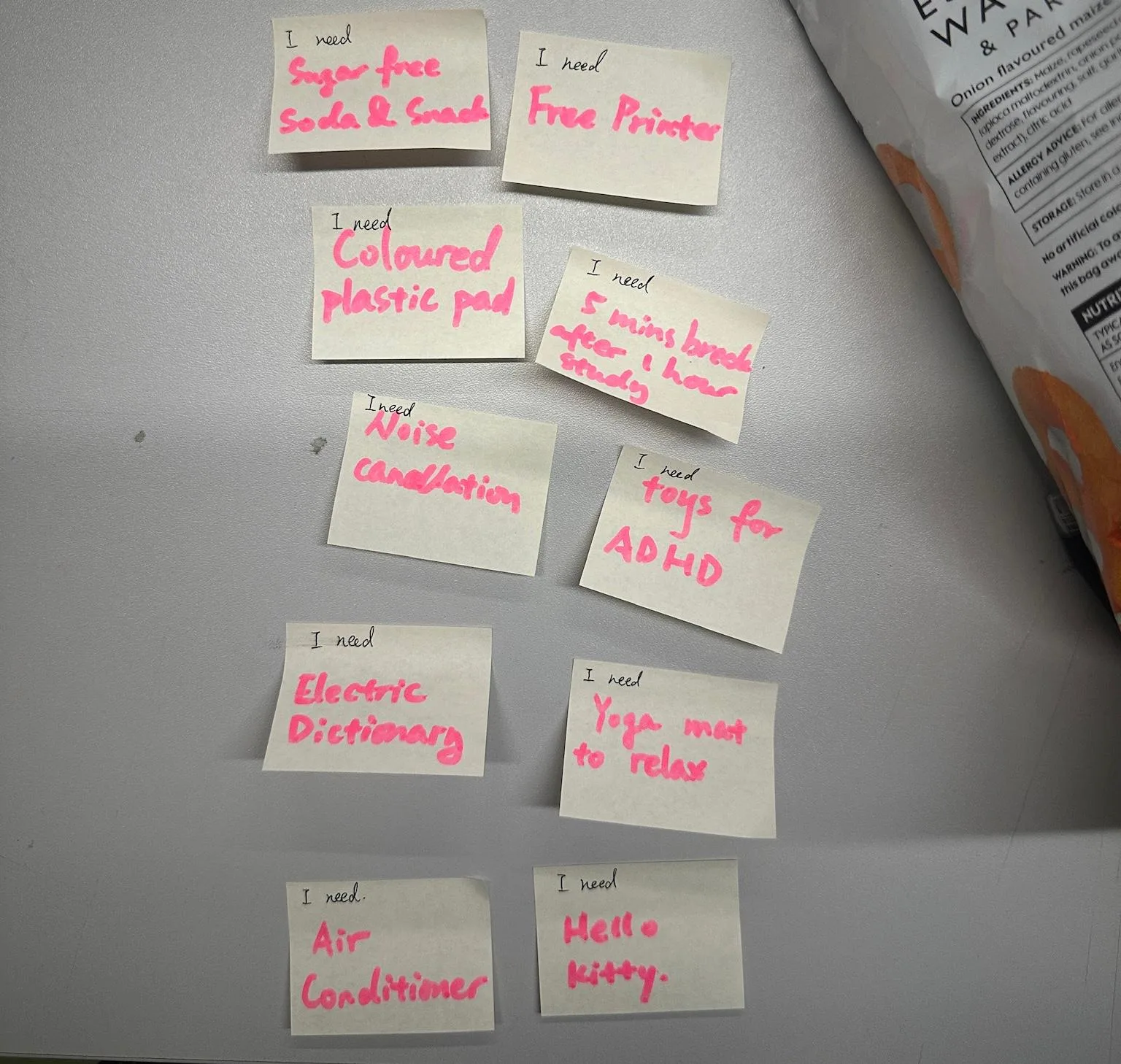
After each task, participants filled out an identical survey asking about their feelings (I focused on feelings rather than quantitative metrics; I felt feelings were more important).
The workshop went smoother than I expected, but one thing took me completely by surprise. During Task 1 (Inclusion), I expected people to be very pragmatic, maybe suppressing voices or ignoring some needs. Instead, the participants, especially my friends, got incredibly fantastical and reimagined the room with wild ideas. I’m not saying it was wrong, but it wasn’t the kind of power suppression I was looking for. Another interesting point, worthy of reflection, is that when I asked the participants to choose their own leader, they refused. I believe this stems, to some extent, from a fear of the responsibilities of power. Even in the task A no one wanted to admit they would be the one “excluded.” This vacancy precisely illustrates that the politics of inclusion is often built on the illusion that “no one wants to be the bad guy.”
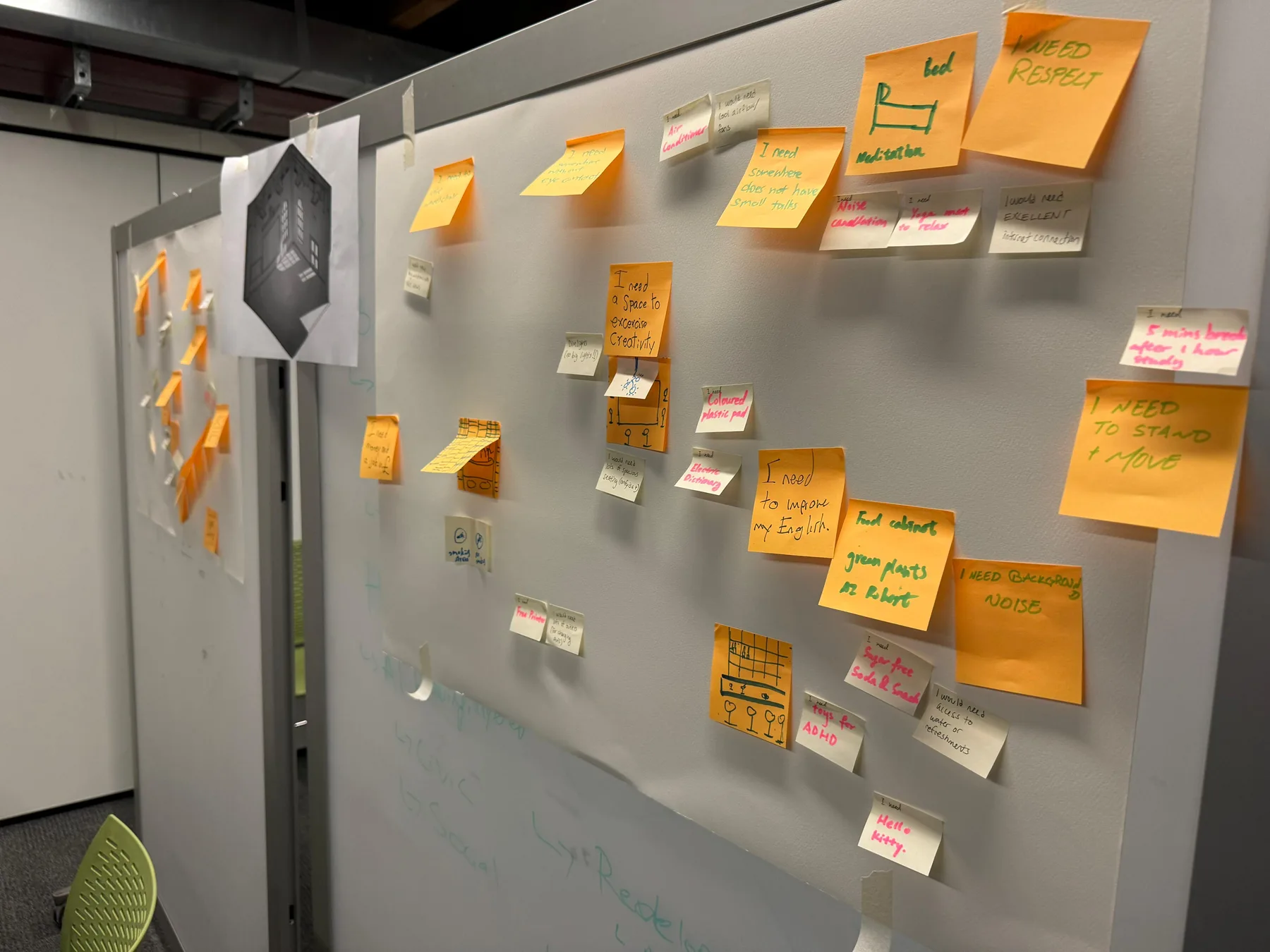
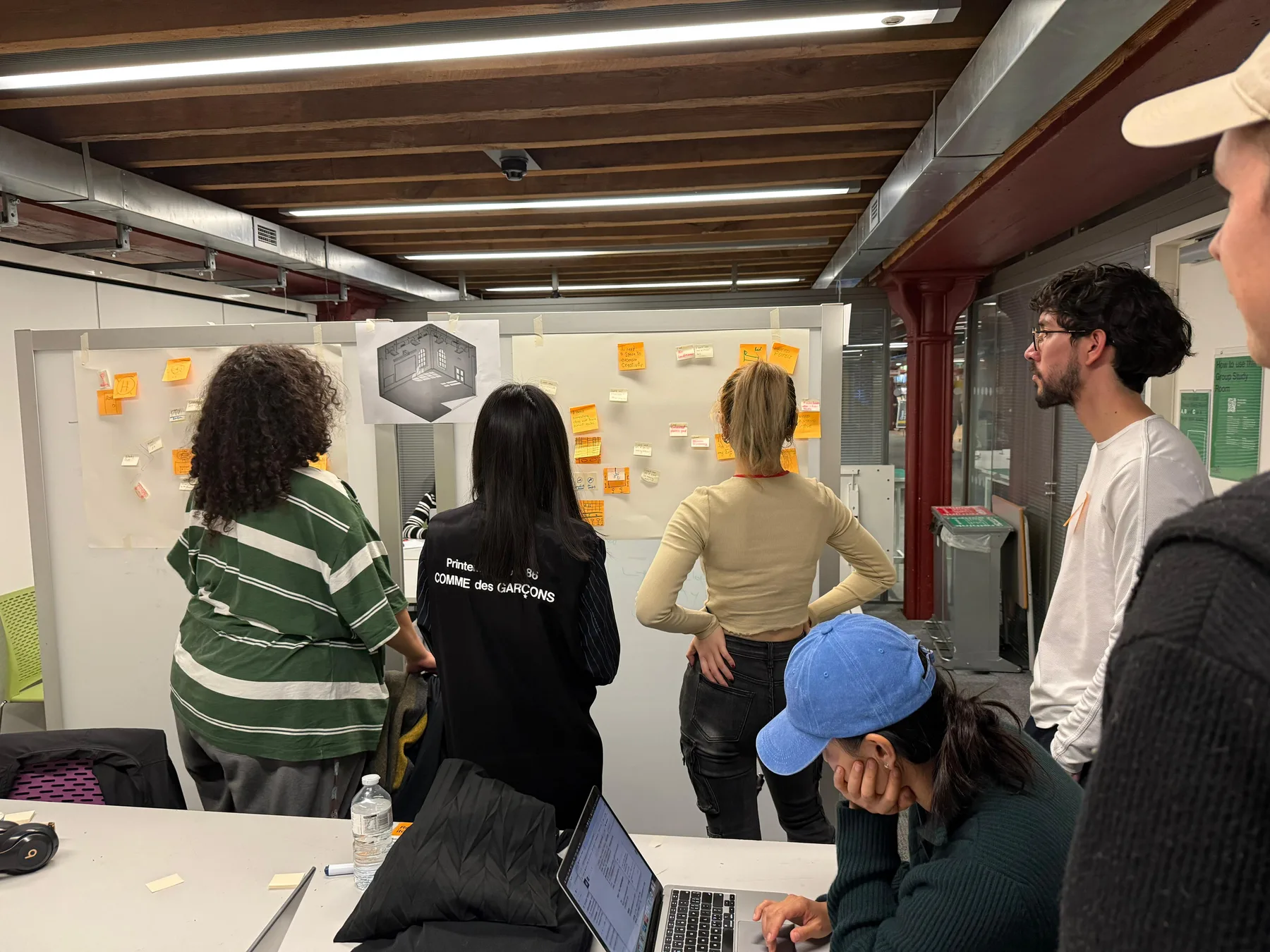
However, in Task 2 (Symbiosis), the general feedback and the surveys overwhelmingly showed that people felt their needs were seen and respected more. Watching everyone gathered around the whiteboard, discussing their needs, was genuinely so beautiful, so loving. The human connection and those vulnerable elements really came out.
But the most critical, unavoidable core problem also surfaced. I explicitly asked the participants during the debrief: it is inherently difficult for people to articulate or conceptualize needs that they do not personally possess.
This issue is damning. It directly addresses the fundamental flaw of the Inclusion Paradigm: If those in power or those designing the social rules (the Normative Empire) can never truly understand the needs that they do not experience, how can they ever design a truly symbiotic space? This is the very heart of my critique, and it was concretely proven in my small workshop. I have two more action research sessions on Wednesday, and my goal for iteration is to delve deeper into articulating and addressing this cognitive and ontological limit of “the inability to perceive the needs of the Other.”
🧠Reflection after Tutorial
📆27/10/2025
Today’s tutorial with Elizabeth really hit me like a ton of bricks. Harsh but really insightful. First, it’s about Intervention. I always understood my project as a discursive intervention, just theoretical critique, write the paper, and call it done. But Elizabeth pointed out the crucial difference: the course demands Action Research, which needs to connect with reality and provide feedback. I can’t just be satisfied with performing deconstruction in the symbolic system. If I just talk without acting, my theoretical critique is an echo in an ivory tower, with no real-world resonance. I genuinely need to push my political agenda onto the ground. Elizabeth then raised an even more cutting issue: while my critique of the Inclusion Paradigm was perfectly understandable and clear, what exactly is my Symbiosis Framework? It’s too vague, and it’s practically invisible in my draft evaluative report.
This Symbiosis Paradigm, based on posthumanism, speaks to an ontological shift: that all beings are fundamentally equal in existence and interconnected. This paradigm leap is really difficult to express in everyday language or to concretize. It’s just too abstract.
I suddenly had a flash of inspiration: since it’s hard to say clearly, let’s go feel it. The best approach would be an embodied test, even a tiny workshop, where participants can physically experience the difference between Inclusion and Symbiosis.
The idea sounds great, but when I think about organizing it in just a few weeks, my heart sinks. For someone on the Asperger’s spectrum like me, initiating social activities and deliberately connecting with the world is taking my life; it’s a structural difficulty. But I can’t hide anymore. My research isn’t abstract philosophy; it’s genuinely tied to the social survival of the neurodivergent, disabled, and marginalized. This real-world urgency demands that I grit my teeth and step outside my comfort zone.
This kinda switching my mindset from “I should do this later” to “I must act now.” Before, I only thought making the framework clear to stakeholders was enough (the accessibility test). But now I understand that simply “making it clear” changes nothing. So, the goal is set: over the next few days, I have to design a workshop prototype to test the Symbiosis Framework. This isn’t just about the assignment; it’s about forcing myself to break through that self-imposed boundary of using “neurodiversity” to explain and escape social connection.
✒️Chating and Thinking after presentation
📆22/10/2025
Today’s post-class discussion got my thoughts tangled up in a corner I usually don’t touch. I was just casually chatting with a few friends in campus’s canteen about today’s presentation and our respective topics, and the conversation naturally drifted to the word, “Inclusion.” They felt the paradigm was indeed problematic, very subtle. Actually, if you think about it, most of issues we’re focusing on ultimately circles back to it.
I suddenly remembered a conversation I had with Gold weeks ago about finding a new word for $disable$, one that was less loaded with discrimination and the sense of “deficiency.” Back then, I just felt the word $disable$ was violent, a crude editorial cut performed by language in the exercise of power. But today I realized the problem goes deeper, to the source: the subject that grants this “goodwill” ($Inclusion$) is itself a trap.
Wittgenstein said that language draws the limits of our world. More importantly, language carries its power structure even before it’s used. It’s never innocent. Once you start to examine it, you find that the structure embedded in the word “Inclusion” is a form of preemptive strike on the symbolic level.
Just like the cruel opposition of $able/disable$, it establishes $able$ as the invisible “default”, and then permanently defines $disable$ as a “subtraction,” a $privation$. In context, it strips bodily diversity of its legitimacy, permanently branding it with the label $not$.
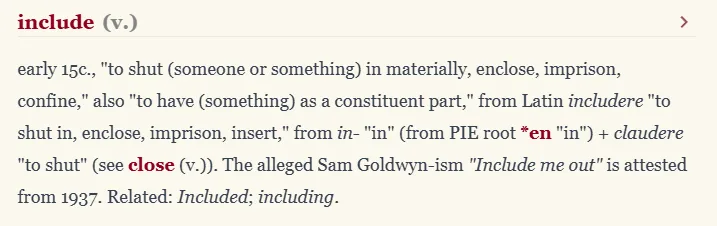
$Inclusion$ is the same, only better disguised. I looked up the etymology and got a chill down my spine. It comes from the Latin $inclusio$, meaning, essentially, “a shutting in,” or “confinement” ($a\ shutting\ in, confinement$). The verb $includere$ is formed from $in-$ (into) and $claudere$ (to close, to lock). This is not about opening up; it’s about closing down.
The root $claudere$ is related to claustrophobia, the fear of confinement. It describes an active, forceful act of “closing the door,” like setting a limit, building a fence, ensuring that something stays “inside” and stops causing trouble “outside.”
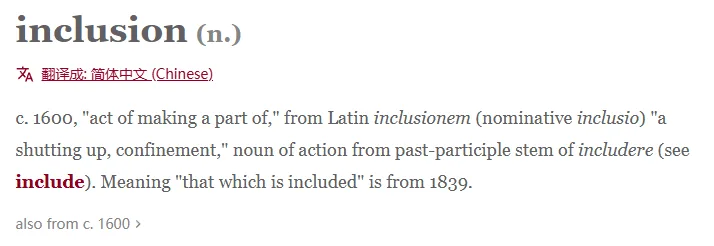
https://www.etymonline.com/word/inclusion
So, the subtext of $Inclusion$ is: There is always a subject ($includer$) exercising the power of this closing. It first establishes its own status as the “container,” the “builder of the walls,” and then charitably permits the Other to be locked inside. The power dynamic is fixed before the word is even spoken. We are eternally the object being accommodated, while they are the masters holding the key.
This makes the political imagination of $Inclusion$ incredibly sparse. It’s only a politics of territory ($a\ politics\ of\ territory$), concerned merely with how to manage its own “empire” (the normative world) and properly contain the “anomaly.” It is absolutely not a politics of relation ($a\ politics\ of\ relation$). It doesn’t strive for $co-existence$ or $symbiosis$, words that suggest equality, reciprocity, or even a mutual breaking down of the old framework.
This kind of vocabulary is an act of self-preservation, a form of ethnocentrism completed on the symbolic level. It promises you a home, but that home is actually a cage with defined boundaries. This is far more suffocating than outright exclusion, because it makes even the gesture of resistance look like a rejection of goodwill.
Besides, we use these words daily to construct our cognition and emotion, yet most of them are contaminated vessels, symbols repeatedly polished by the friction of historical power and inertia. Take the word “Efficiency,” for example. It’s almost sacrosanct in modern society, but at its core, it’s a total negation of life’s non-linearity and purposelessness. It demands that everything must point towards a pre-set “goal” in the most economical, quantifiable way. It performs a semantic castration on the concept of “Waste,” stripping it of the potential contained within: perhaps the unconscious effluence of vitality, the pure $Jouissance$, the non-productive aesthetic that resists the ‘One.’ We fear wasting time, wasting money, wasting talent; we fear everything that isn’t recruited by the commandment of “Efficiency.”
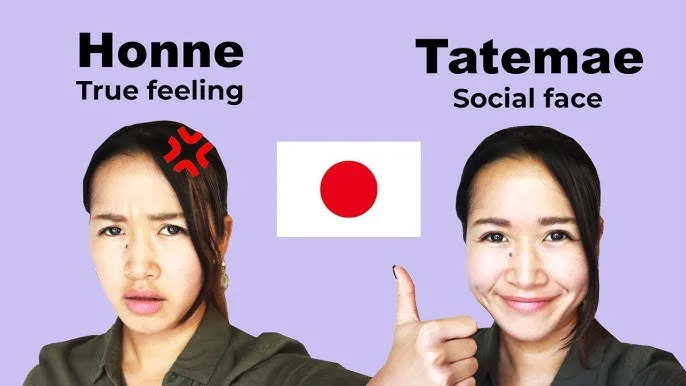
Or consider the Japanese concept of $Tatemae$ (the public facade) versus $Honne$ (the true feelings). This lexical opposition in itself acknowledges the systemic falseness of social interaction. It contextually establishes that “insincere socialization” is not only present but is an order that must be maintained. There is a phrase that Japanese people have for this: 空気を読む(kuukiwoyomu), which means “read the air”. It provides an elegant, cultural sanctuary for the very pressure that forces me to desire society’s desires. We spend our days performing in the castle of $Tatemae$, while the authentic self is locked in the claustrophobic room of $Honne$.
I am suspicious of all those seemingly “positive” words that demand we be uplifting and striving. Are they just mental anesthetics that the Capital-One is constantly injecting into us? “Optimism,” “Positive,” “Gratitude”: beneath their halo of virtue lies a systematic suppression of the subject’s pain and rage. They require us, once we have “seen the One,” not to question, not to revolt, but merely to quietly blow beautiful bubbles in our fishbowl.
There is an inherent Sisyphean futility in using human-created language to critique human-created order. I am using a hammer forged by the “Castle Guard” to try and smash the “Castle” wall. But perhaps true freedom does not lie in inventing a “clean” new word to replace $Inclusion$, but in constantly tearing open and pointing out the contamination and defects of the existing ones. Language, this double-edged sword, is both the cage that confines us and the only tool we have to pry open its seams. Well…anyway, this contradiction and the sense of eternal incompleteness maybe the most authentic truth.
🧠Wonderful Dragon’s Den
📆21/10/2025
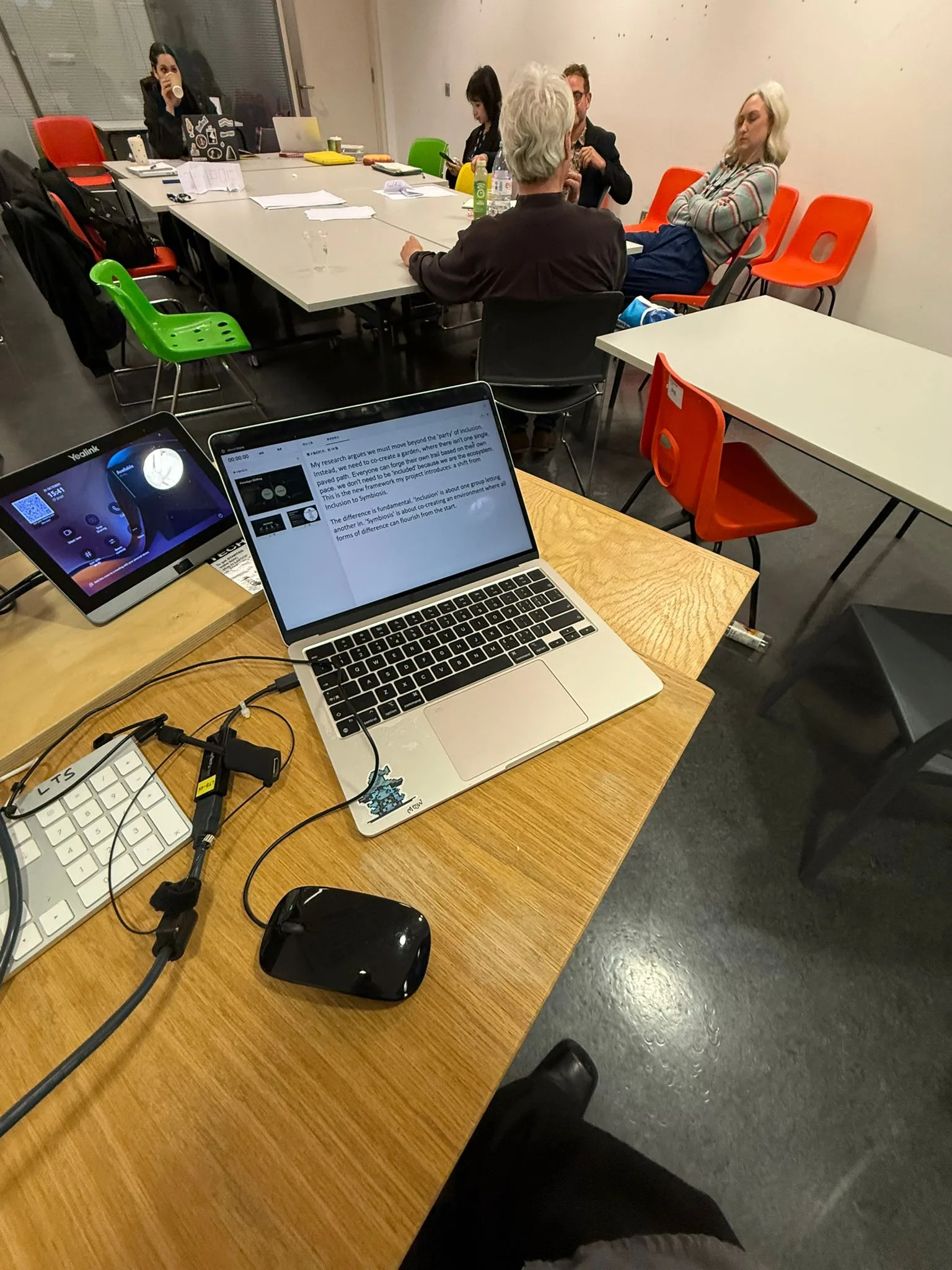
Dragon’s Den finally arrived. Due to ADHD-induced procrastination, I didn’t finish the final presentation structure until the morning of the event, and the script was polished late that afternoon. I fully expected it to be a disaster. Yet, everything went far better than I anticipated; in fact, I think I did really well, at least judging by the feedback from the audience and the guests.
We had two guests: one was an astronomer whose work intersected with art (he seemed very intelligent), and the other worked in social media (I missed her precise introduction because I was late).
My speech began. The entire structure and slides had been heavily revised following Simon’s coaching, which proved incredibly helpful. I refined the argument, added research points, and clearly mapped out my critical trajectory: starting with the deconstruction of the inclusion paradigm within the normative empire, and moving towards the construction of a symbiosis paradigm rooted in posthumanism. Crucially, I incorporated email discussions with scholars like Nick Walker and Chapman, showcasing their input on my framework.
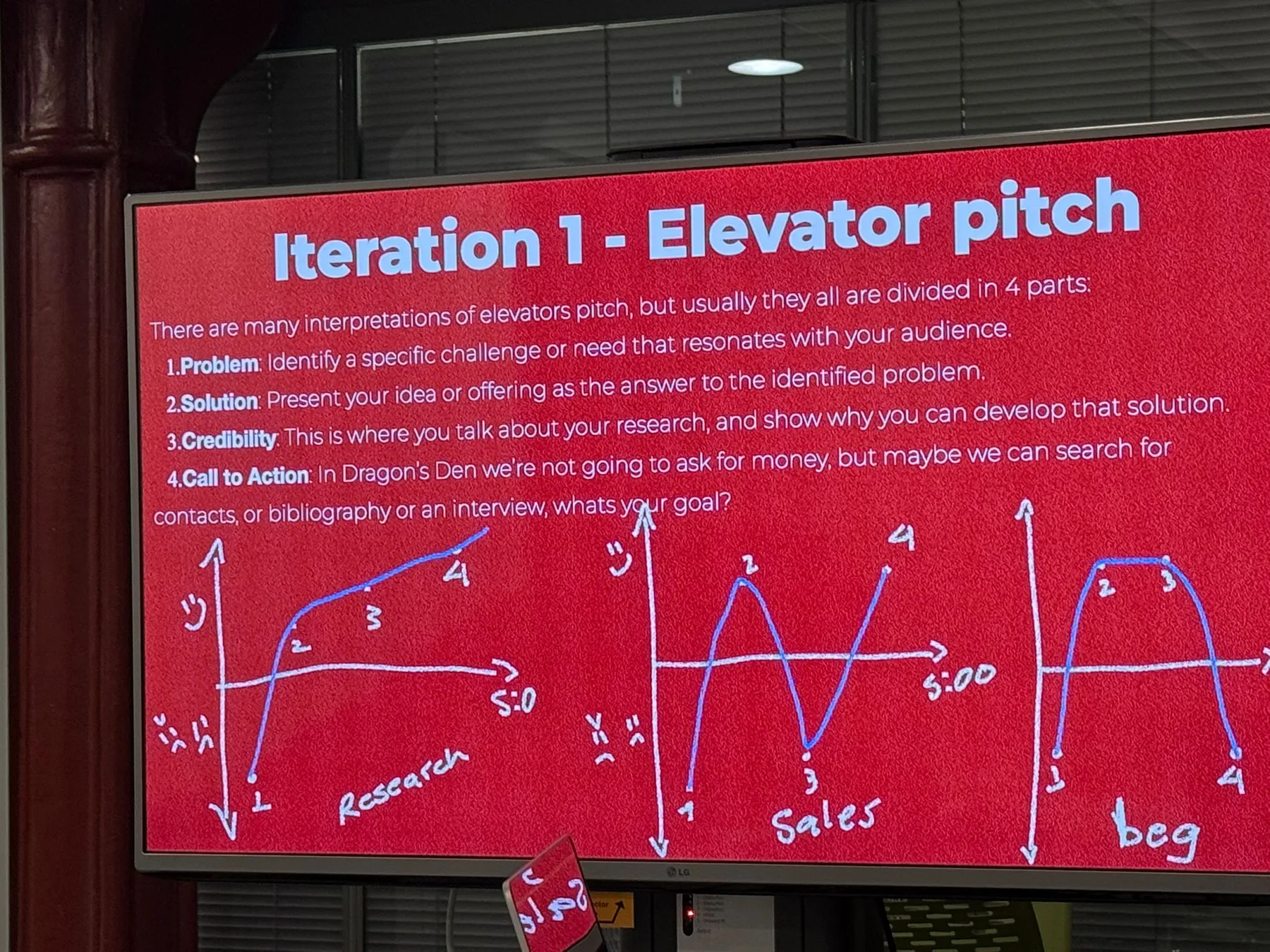
Something unexpected happened on stage. The panic and discomfort I anticipated didn’t materialize. Once I started speaking, I felt like the entire stage belonged to me. It was a powerful demonstration of genuine subjectivity. I wasn’t just performing; I was articulating my value. This may sound self-aggrandizing, or perhaps, in Butler’s terms, it was a highly confident performativity: the display of a successful, soon-to-be-successful image. But for the sake of effectively conveying my core argument, it worked, and that’s what mattered, as my goal was to achieve accessibility.
The guests’ feedback confirmed this. The astronomer repeatedly praised my structure and the compelling nature of my theme. I specifically asked, “Was my delivery clear enough?” They answered affirmatively. This suggests that even for non-academic listeners unfamiliar with neurodiversity or posthumanism, the framework was accessible, understandable, and broadly communicable.
This essentially validated my intervention. Since the presentation (as a micro-intervention) was successful, I feel much more confident about executing the upcoming workshop: using this speaking structure as a base, supplemented by pre- and post-test questionnaires to quantify communicative efficacy. I feel a slight regret that Elizabeth and my other peers couldn’t see it. Although I dislike the act of “showing off,” when I manage to conquer something that causes me pain, I still want to be witnessed. That, too, is another contradictory performative impulse.
Finally, this experience triggered a deeper reflection. I’ve long used my identity on the Asperger’s or autism spectrum to explain (or rationalize) my deep resistance to public speaking and eye contact, framing it as an innate, irresistible barrier. But if I can perform with such confidence, fluency, and even charisma on stage, what does that imply? Does it suggest that what I perceive as my “unsuitability” or “lack of talent” is merely another form of reverse-performativity?
In my thesis, I discuss how neuro-mimicry is a form of Butlerian performativity: just like performing the heterosexual matrix, it is a contingent mode shaped by social power structures, not a natural truth. Am I, then, engaging in a “neurodiversity performativity”? Am I deliberately reinforcing certain traits like “introversion” or “social difficulty” to solidify subjective grounds for escape or explanation?
The ADHD part is hard to fake; the instinctual refusal of linearity and quiet processes feels genuinely outside my control. But in other aspects, do I unconsciously mimic and reinforce this specific otherness? Especially in the context of late capitalism, where power structures might seek to enhance this “neurodiversity performativity”, packaging it as a manageable, desirable, or innovative trait: what I critique as “Neuro-Thatcherism.” Allow me to refer myself:
🧠Simon’s session for presentation
📆14/10/2023
The other day, Simon asked in our learning group if anyone wanted to participate in his presentation skill session, and I signed up without hesitation. Frankly, public speaking is a nightmare for me, easily my biggest pain point. I desperately want to avoid it, especially in settings like the Dragon’s Den. Standing in front of a group of people triggers intense anxiety and discomfort; I’ve even had panic attacks during talks, especially when using a second language. I remember one specific instance in class.
Yet, despite all this, I went to Simon’s session. Why? Firstly, because I want to execute this well. As I wrote last week, I need to articulate my project clearly and powerfully at the Dragon’s Den; it’s a critical test of my accessibility and communication efficacy, and I view the presentation itself as an act of social intervention. Secondly, there’s the sense of social obligation. This session is Simon’s intervention project, and as a friend, I felt compelled to participate in a supportive role (but I’m glad to).
When the session started, I was totally unprepared; I hadn’t even touched the slides for the Dragon’s Den. I only had a few lines ready and just improvised for less than four minutes. But Simon’s structure was brilliant: he used about nine metrics to measure different aspects of the speech. An interesting finding emerged: my project scored high on “Impact” and “Necessity.” Since my theme is neurodiversity, it concerns everyone’s mode of existence and subjectivity. It carries a greater social urgency compared to some commercially focused business plans or branding projects. I’m not suggesting a hierarchy of value, but for me, the spontaneity and internal drive behind it makes its necessity self-evident.
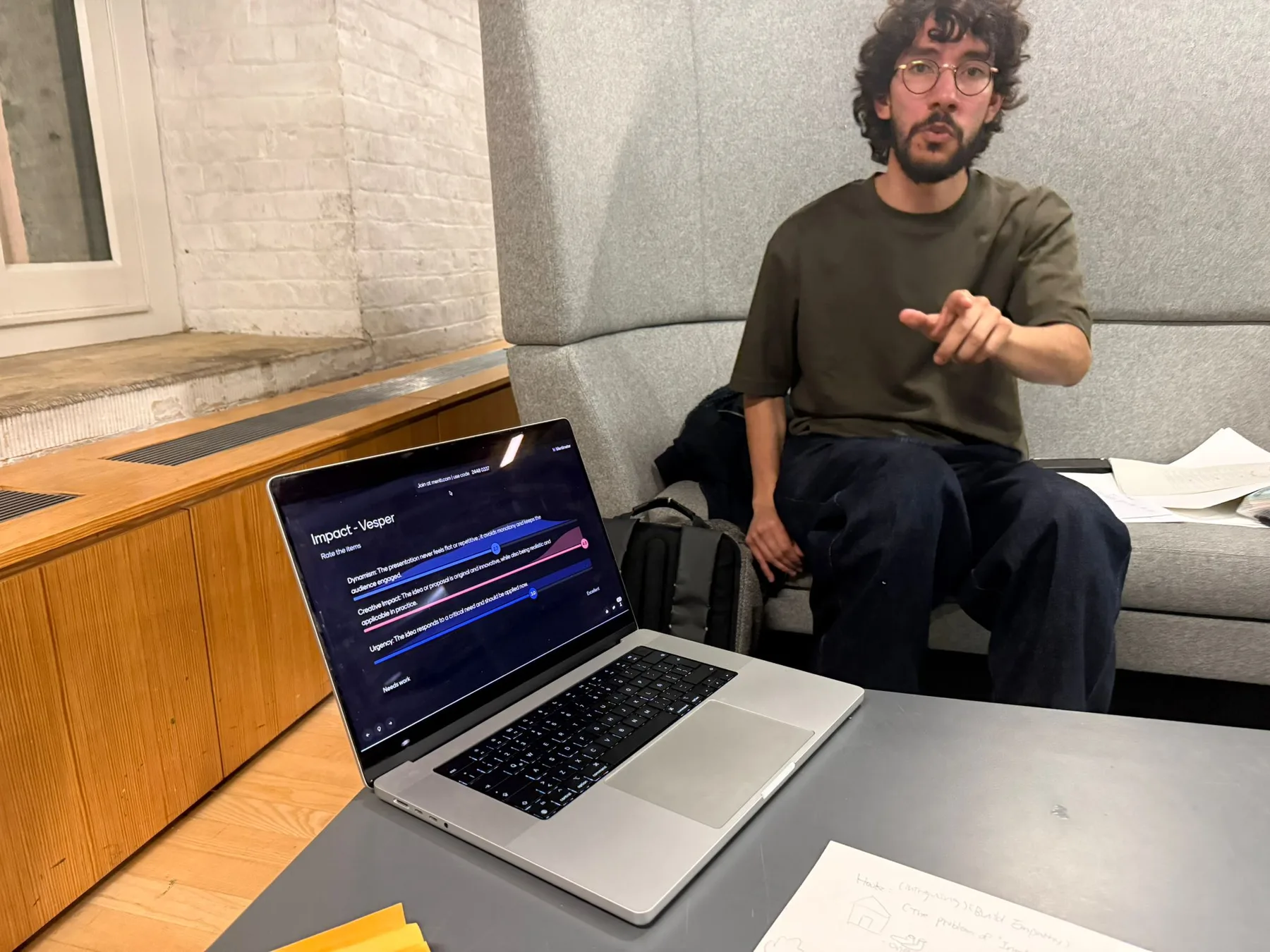
However, my scores were naturally low on presentation structure and data support, because I hadn’t prepared any. Simon pointed this out directly. His feedback was laser-focused: the next steps must be to reinforce my evidence chain and research data.
Interestingly, the audience (including Simon) felt my critical structure was clear, and my opening hook was effective. They found the metaphor about house and garden was engaging, allowing one listener to feel genuinely included in the otherwise complex subject. They felt that even an audience unfamiliar with neurodiversity or posthumanism could grasp my core argument. That was very encouraging.
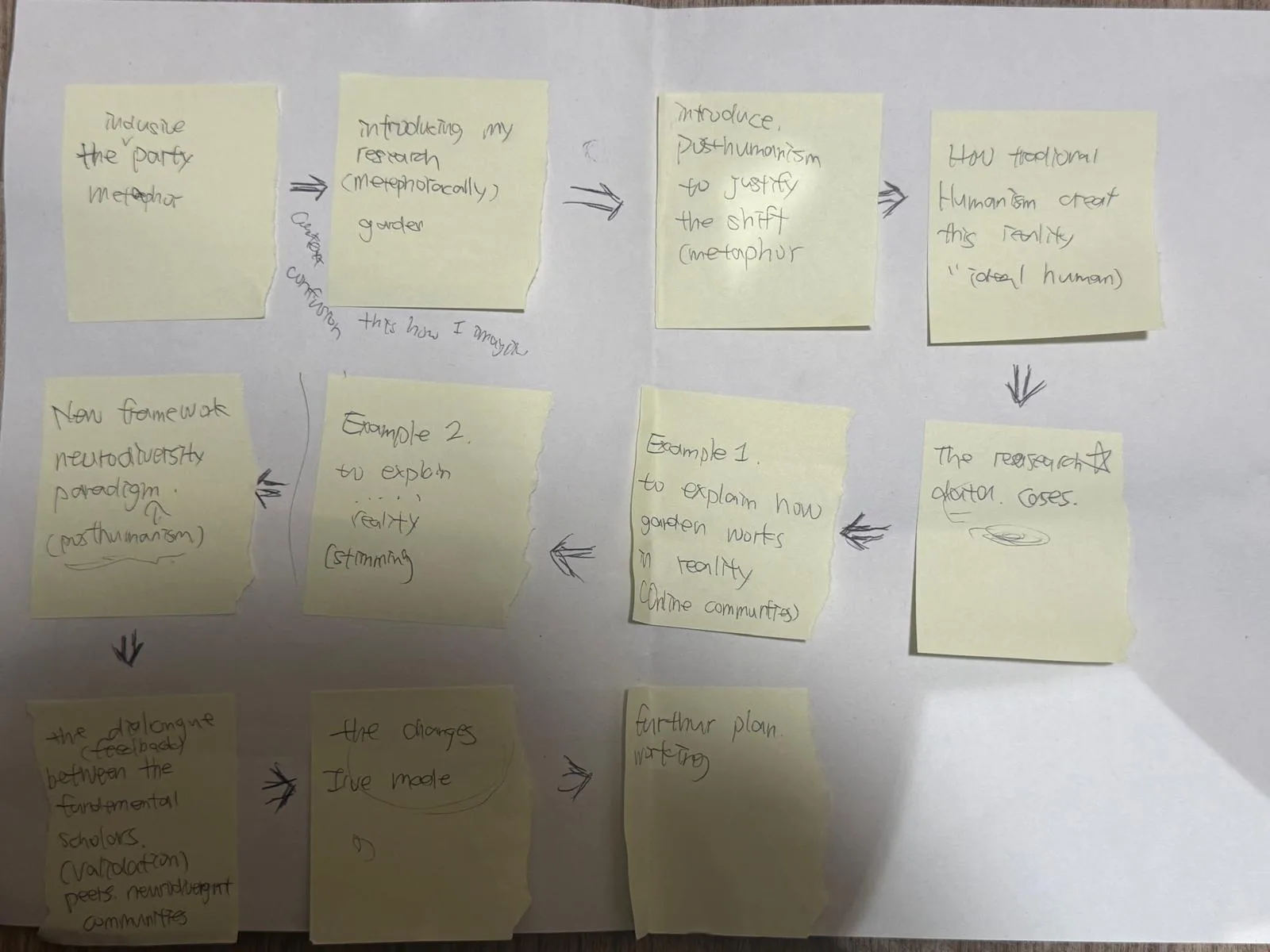
So, my goal is now clear. I need to articulate precisely what my project aims to do, what my next objectives are, and how I methodologically arrive at the new paradigm of posthumanism or symbiosis.
Verbal delivery remains a significant hurdle. Articulating complex academic issues in a second language doubles the difficulty. While English grammar might be better suited for certain philosophical arguments than Chinese, reading philosophy texts is one thing; truly fluently articulating and defending these concepts in spoken English is another. Especially under the pressure of an audience, this is an area I absolutely must improve.
All in all, while I’m filled with anxiety and tension about next week’s presentation, having taken this first step means I must see it through. I don’t know how it will go, but I’ll go into it fully prepared, and I’ll accept whatever outcome my preparation yields.
🧠Reflection on Accessibility
📆9/10/2025
I’m feeling a bit confused about today’s Shut Up and Write session. I don’t really get why we have to use class time just to work on our own stuff, especially all crammed together, practically touching elbows. Maybe for some students who usually struggle to ask questions or don’t feel motivated enough, this format gives them an easy, institutionalized step to engage. But it genuinely doesn’t fit my working style or how I think. I’m much better suited for studying and thinking late at night, when everything is quiet. Having other people actively thinking around me actually distracts me. My mind just tends to reject that centralized, daytime, linear mode of working.
That said, it doesn’t mean I don’t want to talk. Quite the opposite, I love discussing and listening to other people’s projects and ideas. But I always catch myself wondering: am I genuinely curious about their perspectives, or do I secretly enjoy that little rush of satisfaction from spotting a flaw in their argument and temporarily occupying a position of knowledge? I have to admit that in many social settings, I’m terrible at reading the room; I might actually be on the autism spectrum somewhere. However, in my experience, people who enjoy thinking are usually the ones most eager to learn new, mind-bending things.
Anyway, I’m getting off track. I managed to finish the outline for the evaluative report during the session and showed it to Richard and Zuleika. They hit me with a very crucial, constructive question: How do you measure your project? My work (the theme of neurodiversity and posthumanism) is mostly a theoretical framework, an academic paper. But how do I prove its “effect” or impact? This immediately brought up the accessibility issue that Elizabeth had mentioned to me: how do I take this relatively dense, new framework and get it across to the general public, people who aren’t academics or who simply don’t care about the topic?
This question forced me to pause and really think. It’s obvious my project is socially oriented; it’s directly linked to the current social environment and to the neurodivergent community I belong to. It’s not about some purely abstract, metaphysical debate about the “meaning of man,” but about how marginalized groups and other non-normative individuals can survive better in this current system. Therefore, my theme (posthumanism and neurodiversity) must be accessible.
I realized I’d been subconsciously resisting this push toward “practical application,” always preferring to stay in pure theoretical critique. That was probably my scholarly evasion. But I now see it’s essential. The deepest reason I chose this topic is that it relates directly to my own life: my ADHD, my background, and my experiences of being excluded. If that’s the case, why wouldn’t I translate my critique and political agenda into something that people like me, or even those not in my immediate group, can easily understand?
I wouldn’t call it redemption, but I feel it’s a necessary responsibility to fulfill. I’m currently designing a workshop, maybe similar in style to Professor Nick Walker’s clear explanations of neuroqueer theory. My goal is simply to make my framework clear and comprehensible enough for non-academic audiences, so the idea can be spread through broader social platforms.
Dragon’s Den coming up soon, which I think will be a perfect chance to test the accessibility of my project. Before submitting the final report, I think I’m going to plan to design a questionnaire to quantify the effectiveness of this communication. For example, before the session, I’ll ask about participants’ existing understanding of terms like “neurodiversity”; then, 5 or 10 minutes after my explanation, I’ll give a similar test. This will allow me to measure the comprehensibility of the new framework and the efficacy of the communication. It’s deeply ironic: I have to use the very symbolic system I criticize, which demands efficiency and quantification (surveys and data), to prove that my resistance is working.
🧠Why I CHOOSE Posthumanism
📆29/9/2025
To be honest, when I try to psychoanalyse myself, there’s this huge resistance. It’s like how a therapist can’t treat themselves, or a barber can’t cut their own hair (though maybe a real pro could manage it with a mirror). But I still want to give it a go. Psychoanalysis isn’t really the same as the “reflection” the course demands, even if they overlap. But when Richard showed us some previous students’ reflective journals, most of them were just… chronological accounts, or just talking in circles. Obviously, everyone has their own way of thinking, their own mindset, and there’s no hierarchy of thought, it’s just… that’s not how I reflect. Before Unit 4, I tended to write in a more literary, poetic way, but that was bloody exhausting, especially with my perfectionism. So, for this unit, I’m planning to just try and present my thought process as it is. Plus, I have relatively huge ADHD, which I think you’ll probably be able to feel in how I think as you read this.
I think this journey has to start with the theme that’s run through this whole academic year: posthumanism. The first time I heard that term, my gut reaction was a kind of post-apocalyptic world state. Maybe a nuclear winter, humanity’s almost gone, plants starting to cover the skyscrapers. Or a world where humanity faces some crisis that’s bigger than them, and all the old social orders just collapse. Or, failing that, a world completely detached from our reality. This is why I’m obsessed with fantasy works, like Tolkien’s Middle-earth, Elden Ring, Dune, that sort of thing.
In those scenarios, I just feel… lighter, whether I’m in them or not. It feels like there isn’t some… some Big Other oppressing me, forcing me to desire what society desires, forcing me into all this fake, phoney socialising, to just get on with a cookie-cutter life, grow up, pursue so-called happiness, chase the ONE. This ONE is something I read about in an article on the “mountain-peak culture” (山头文化) in East Asian societies. This “peak” has always loomed over the East Asian continent. I once wrote a bit of dialogue in a novel of mine: “And so, generation after generation, a vast, intricate, yet tedious castle came into being. Inside the castle was a priceless treasure, the thing that everything pointed to—the ONE! The entry pass was an unquestioning pursuit of this ONE If you showed even a hint of doubt, you were barred from the castle for life! But now, a naive child stood trembling at the castle gates, only to be seized by a guard. The guard roared, ‘You little bastard, what do you think you’re doing? You’ve got some nerve, trying to defy me? I’ll cut your bloody balls off!’ He grabbed the child tight and, just like that, castrated him. Then, he took off his helmet, and guess what? It was the child’s own father. That poor child… he could never again truly, genuinely pursue anything. His hands, which could have created worlds, fell limp. The light in his eyes, which once chased the stars, slowly dimmed. He said, ‘I see the ONE now.’ And from then on, he lived out the rest of his days like a goldfish in a bowl.”
But all of this just makes me feel suffocated, makes me want to escape. It’s not something I can control. So I have this instinctive pull towards posthumanism, or post-apocalyptic concepts. Maybe it’s just escapism from the world as it is. Or, to use my consistent (and not in a good way) language, maybe it’s a kind of spiritual patricide? That patriarchal order that demands I just “play human” by the rules, that Law that was imposed on me before I even knew who I was… can it really be destroyed in my post-apocalyptic ruins?
What’s more, it’s not like the Law exists first. It’s the very desire to break and transgress the Law that is the fundamental precondition for the Law’s existence in the first place. Meaning, the desire to transgress retrospectively creates the Law it wants to transgress, and in doing so, it constructs the pre-transgression paradise, the Paradise Lost before Adam took a bite of the forbidden fruit. So, I’m not really inclined to fantasise about a pre-human world, a paradise. Because it was humans who built this society and its symbolic order, which is what allows humans to even fantasise about a pre-paradise, that womb-like, quiet, full, unified, blissful pastoral age. Quite the opposite, in fact. I want to imagine, I desire, that post-human world, whether that’s “post” in a timeline sense or an ideological one. I love a quote from Proust: “The only real paradise is the paradise we have lost, the only attractive world is the one we have not yet entered.” But to put it another way, my own experiences of being marginalised are perhaps the real-world root of this patricidal impulse. When I, as an individual, can’t get my subjectivity recognised by the existing symbolic system, then destroying the entire system becomes the ultimate solution. It sounds dramatic, I know, but I have to admit I have that tendency. And I am absolutely certain I’m not the only one who thinks this way.
I was reading Foucault’s The Order of Things, and there’s that line, “man is an invention… and that he would be erased, like a face drawn in sand at the edge of the sea.” For some reason, I felt so… relieved when I read that. I felt, “Ah, so humanity isn’t that important after all.” And this wasn’t just wishful thinking. Human society isn’t that important. The order humans created, their values, none of it is that important. All the things they think are so vital, the things they can’t let go of, the things they think are innate or desperately crave… all of it can just pass away. But when I say, “humanity isn’t that important,” what I’m really saying is, “my pain isn’t that important either.” To use an analogy, it’s like Camus’s Sisyphus, pushing his rock up the hill, suddenly realising that even the gods aren’t watching his labour anymore.
But, of course, I have to admit, just because it’s a post-human world doesn’t mean “the One” will be gone. Me, using my human brain to imagine a post-human world… it’s just like what Foucault criticised: man as the “empirical-transcendental duplicate.” We are both the empirical object to be observed, analysed, and categorised, and also the transcendental condition that makes knowledge possible in the first place. My thoughts are a product of history and contingency, born in the cracks of this specific era. How can I possibly imagine a world I’ve never experienced? I can’t experience a Poincaré recurrence, I’m not a black hole without Hawking radiation. This life is the life I get to experience.
My position on the world right now… even though I hate to say it, being one of them… I hate humans. I loathe anthropocentrism. But at the same time, humans created art and philosophy. They have curiosity, an instinct for knowledge. Their desire to transgress makes them shine, and it also makes them suffer endlessly. Humans are arrogant and cruel. They put themselves in this supreme position in the world from the very beginning, basically giving themselves a free pass to exploit all non-human existence. It’s a precondition they just invented. It was never a priori true. Just because humans can think about their place in the world doesn’t mean they get to put themselves at the top. And beneath this throne, animals become resources, nature becomes a backdrop, technology becomes a tool. And just as lethally, this way of thinking creates a “standard human” paradigm, which systematically excludes and marginalises any human who doesn’t fit that mould.
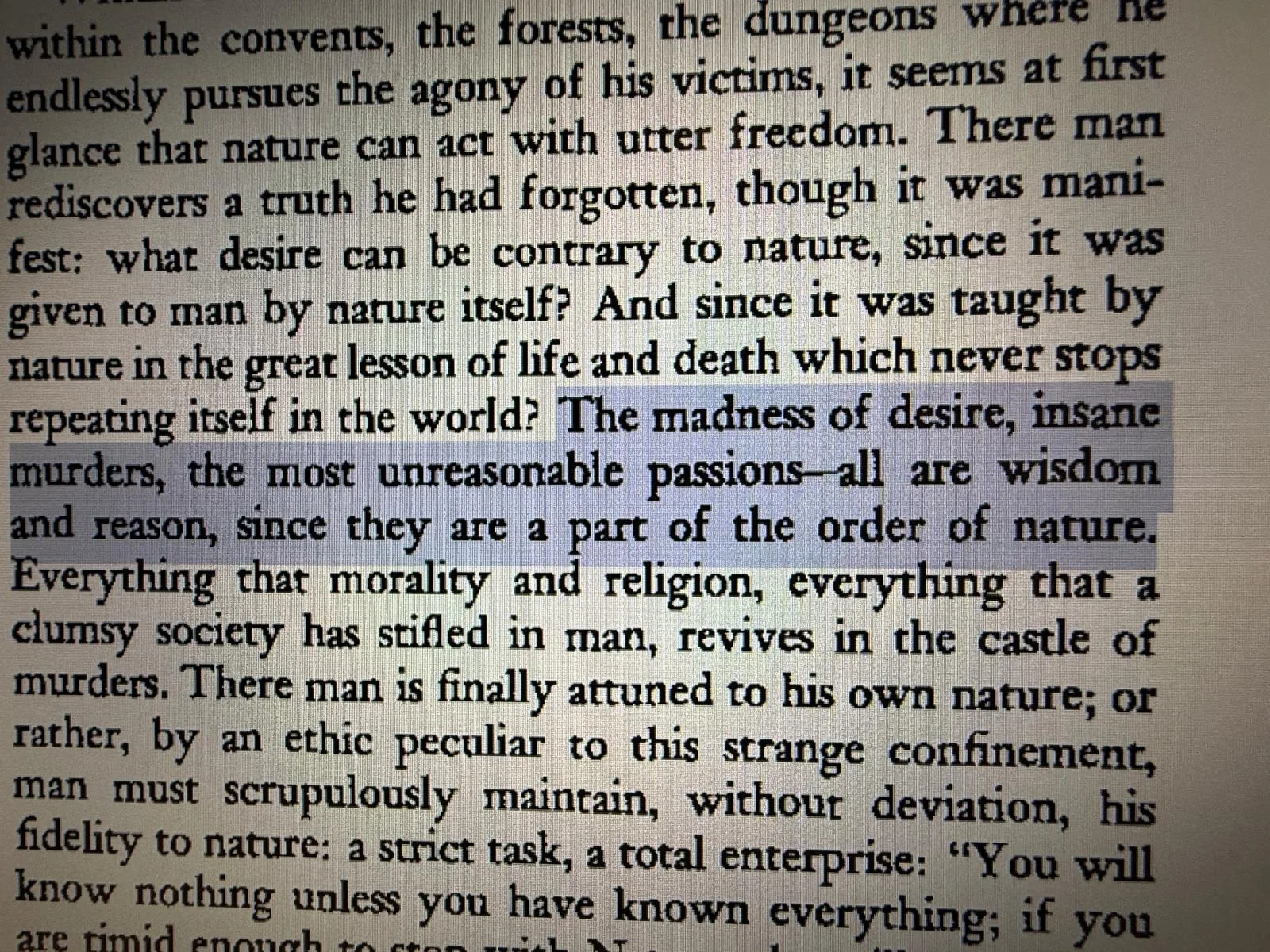
I don’t want to understand humanity by “transcending” it, because I do understand humanity (hopefully). People don’t change. The good and the evil in people are just part of the package. How can man build a heaven on earth? Doesn’t all of failed communism prove that? And this desire to “transcend” humanity… isn’t that just my own humanity luring me on? Even if we transcended, we still wouldn’t be satisfied. My feelings about technology… brain-computer interfaces, space exploration, AI, consciousness uploading… it’s contradictory. I want to see these developments (and that includes an AI rebellion, which links back to my post-apocalyptic thing). I don’t know, does that make me a techno-progressive? You could say I’m not even scared of the birth of overly-advanced, destructive technologies. I have this faint feeling that my subconscious is craving a rebirth brought on by a technological singularity, like a foetus actively tearing its way out of the womb, even if the process is bloody and full of unknowns.
This craving for a “tearing,” this yearning for a violent new beginning, is really the reversal and revenge for that castration ceremony. That castle guard, that father figure… he used his Law, used that “ONE,” to make a cut. A cut designed to separate and tame me. He ripped me out of that chaotic state of original potential and moulded me into a follower of the “One,” a goldfish in a bowl.
And the technological singularity I desire now, or that post-apocalyptic disaster I’m fantasising about… that’s another cut. But this time, I’m the one making it. I’m going to actively cut away the rigid symbolic order that has alienated me and wrapped me up. I’m no longer the child passively enduring castration. I’m going to be the foetus actively tearing its way out of the “womb.” This reminds me of a topic my classmate was originally interested in, artificial wombs, which intersects with the Haraway/cyborg stuff I was researching. It’s a shame she didn’t carry on with it. What does the womb even mean for the human species? Is it paradise lost? The end of desire? Or is it just an organ that adds to the sum of suffering (both for the mother enduring nine months and the agony of childbirth, and for the child about to face its own unknown suffering)?
Sometimes I think… that guard, that father… is he a victim himself? Was he once that same trembling child at the castle gate? The reason he’s so skilled at performing the castration is maybe just because he was castrated himself, long ago. He had no choice but to pass on the trauma and the system. The gospel says, “all they that take the sword shall perish with the sword.” But in this context, it’s more like: “he who wields the knife was already killed by it.” That is the most terrifying part of that “mountain-peak culture.” It’s not simple oppression; it’s a self-replicating chain of trauma, a massive con that everyone is in on. So maybe my patricidal urge isn’t just aimed at the lofty “One.” Maybe it’s about severing this repetitive, unoriginal, utterly boring tragedy.
Which brings me back to my aversion to “talking in circles.” Aren’t those repetitive, empty, by-the-book reflections just the “goldfish in the bowl,” safely blowing bubbles? They’re using what looks like “reflective language” to just repeat the Law, to constantly reaffirm the existence and authority of the “One.”
I’m scared of falling into that repetition myself. Me, with my literature, my poetry, my complex theories… me analysing Lacan, Foucault, posthumanism… am I just pushing the stone up the hill in a more refined, more intellectual, more self-satisfied way? My resistance, my analysis, my non-conformity… has all of it already been anticipated by the Big Other? Has it already prepared a neat little label for me, “The Rebel,” a nice little niche as the “marginalised intellectual”? Letting me think I’m resisting, when really I’m just playing another pre-assigned role in the castle: “The Woke Observer.”
This might be where my ADHD is my only insurance policy. Its leaps, its lack of control, its non-linearity… that’s the stuff the symbolic order finds hardest to digest, hardest to integrate. Order demands linearity. It demands logical closure, A to B to C. But my mind… it’s always spilling over. It jumps from point A straight to a distant Omega, ignoring all the established paths and traffic lights. That spillage… that is life force itself. It’s that raw jouissance the guard wanted to cut off in the first place.
So when I get lost in Middle-earth or Elden Ring, I’m not looking for a new ONE to worship. Quite the opposite: the ONE in those worlds (like Sauron, or the Golden Order) is just as oppressive and suffocating. What I’m fascinated by are the gaps that exist in those worlds, the parts that escape the system’s control: Tom Bombadil’s ancient forest, the Lands Between after the Ring is shattered. I’m longing for the possibility that’s outside the system. Ranni’s Age of Stars.
I loathe anthropocentrism, but here I am, forced to use human language, human philosophy. I feel like a prisoner trying to plan a breakout using the prison’s own blueprints. The art and philosophy humans have created… they’re brilliant, sure, but aren’t they just more exquisite cages? A more advanced form of phoniness? They comfort us, they let us “see the One” after we’ve been castrated, and even feel moved by it, making us willingly put up with this life in the goldfish bowl.
That’s why I’m not afraid of destructive technology. I’m secretly hoping for it. I’m waiting for an “Other” that is completely outside the human frame of reference: a true AI, an alien civilisation, something. Because only an “Other” like that can bring something truly new. It would be like an absolutely alien mirror, one that reflects the utter absurdity of the human castle. Under its gaze, that ONE would seem tiny, ridiculous, and completely irrelevant. I think I’m starting to get it. What I crave isn’t human transcendence; it’s the obsolescence of human order. When that castle guard (the father) is faced with an AI he cannot possibly understand, cannot castrate, cannot bring under his Law… what will he do? His whole threat of “cutting your bloody balls off” would just collapse instantly, because the AI doesn’t have any (at least, not yet). In that moment, that trembling child, the “me” who was cut off from everything, might finally be free. This isn’t patricide anymore. This is making the very concept of “the Father”, along with his castle, his Law, and his ONE, completely and utterly obsolete.